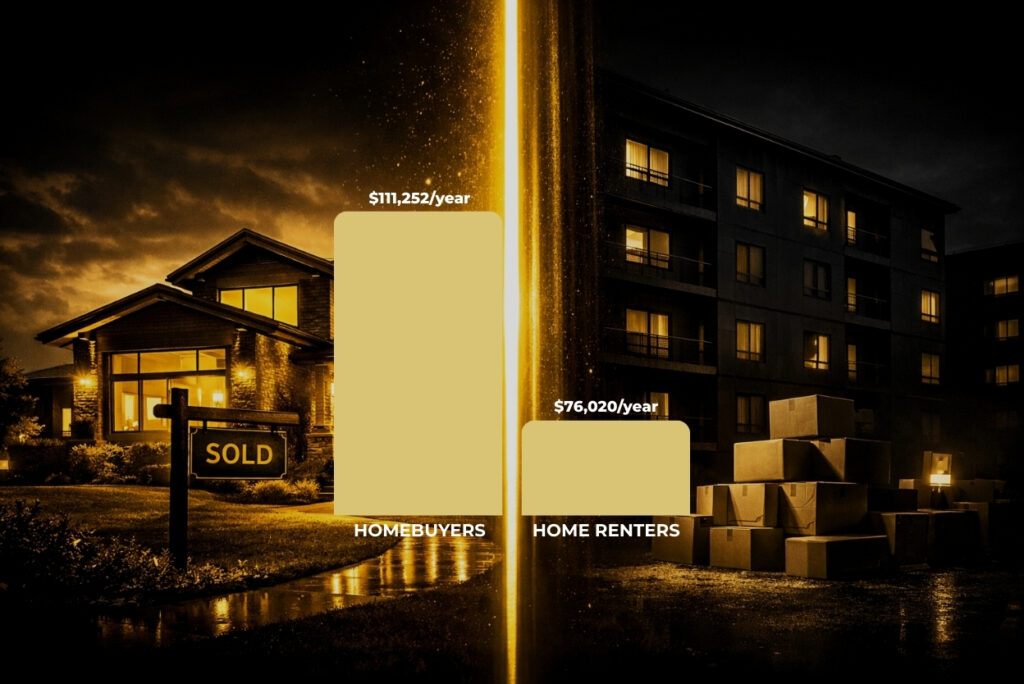
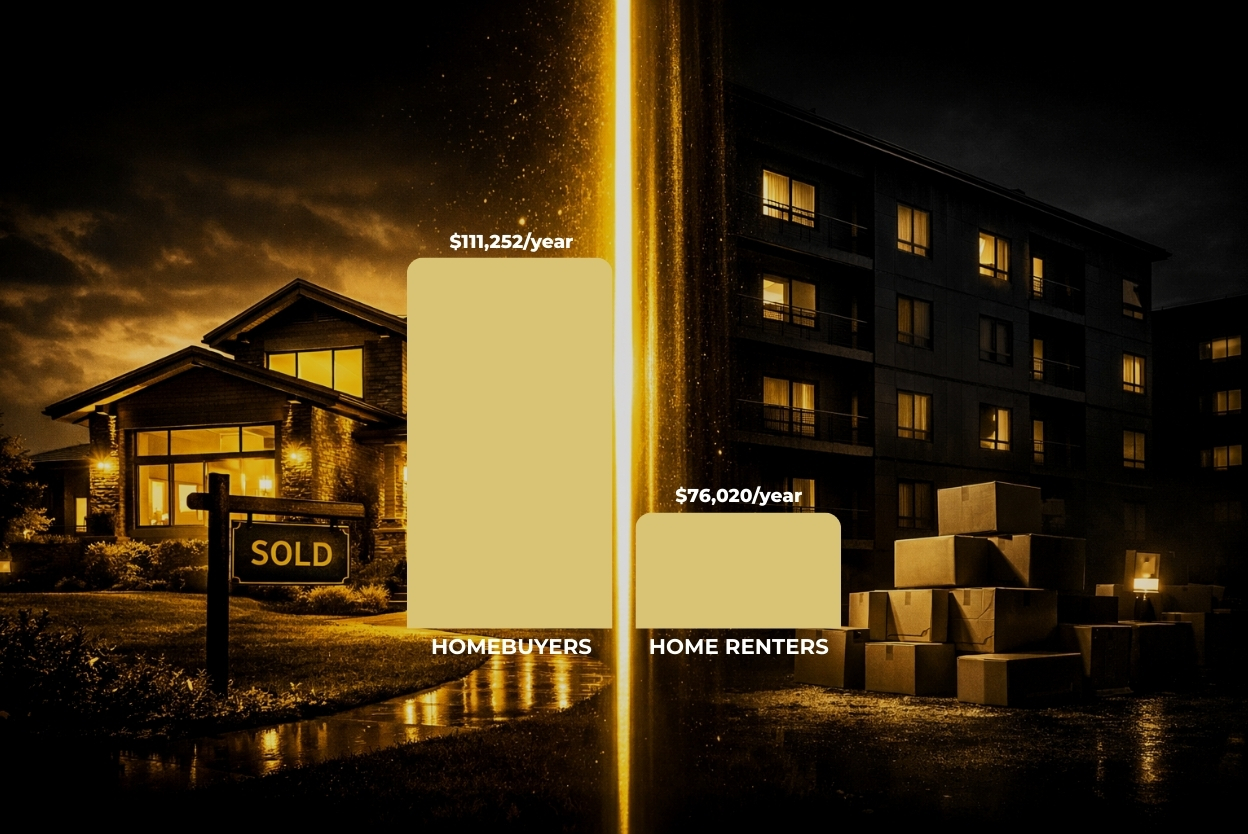

According to Redfin, buyers must earn $111,252 a year to afford the typical home, compared with $76,020 to afford the typical rental, a 46.3% premium.
Put another way, homebuyers now need to earn roughly $35,000 more than renters to afford their monthly housing payment.
Still a sizable chunk. But it’s the smallest gap in three years.
A year ago, buyers needed to earn 55.6% more than renters. In late 2023, that premium peaked at 66.2%.
What’s changed? Mortgage rates have eased from nearly 7% to around 6.1%. Monthly payments have dropped from roughly $2,800 to about $2,675.
At the same time, rents have climbed 2.1% year over year, even as wage growth hit 3.7%.
Redfin economist Grishma Bhattarai explained it this way:
“Many Americans have been hesitant to jump from renting to buying due to high homeownership costs, but the recent drop in mortgage rates and rise in homebuyer negotiating power may help some take the leap
“We expect homebuying affordability to gradually improve in the coming year as mortgage rates stay closer to 6% than 7%, home-price growth loses steam and wages rise faster than housing costs.”
The Gap Is Still Big, But It’s Moving in Buyers’ Favor
Buying still costs more than renting. No way around that. The typical household earns $86,185. To afford the median-priced home, a buyer needs to earn $111,252. That’s about a $25,000 gap.
Last year, that gap was closer to $33,000.
The income required to buy fell 4% year over year in December. And the median income rose 4%. That’s why the pressure is easing a bit.
The rent-versus-buy premium tells the same story. Buyers needed to earn 55.6% more than renters a year ago. In late 2023, that premium peaked at 66.2%.
Now it’s 46.3%. Still wide, but clearly smaller.
Rates are part of it. The average mortgage rate is around 6.1%, down from nearly 7% last year. The median monthly mortgage payment dropped from about $2,800 to roughly $2,675, even though the median home-sale price is $426,747.
Rent isn’t exactly getting cheaper. The median asking rent is $1,901, up 2.1% year over year. But wages are up 3.7%, so renters are treading water instead of falling behind.
Bottom line. Buying is still harder. It’s just not moving further out of reach the way it was in 2023.
Where the Buy Premium Gets Extreme
National averages only tell part of the story. In some markets, the gap between renting and buying is massive.
Start with the Bay Area.
- San Jose, CA
- $374,241 income needed to buy
- Buyers must earn 175% more than renters
- Down from 207% a year ago
- Average monthly mortgage payment over $9,000
- Typical rent: $3,399
- San Francisco, CA
- $291,256 income needed to buy
- 138% more than renting
- Down from 152% last year
- Seattle, WA
- $192,503 income needed
- 120% premium
- Down from 136%
- Sacramento, CA
- 67% premium, down from 83%
- Los Angeles, CA
- 115% premium, down from 130%
Even with the gap shrinking, buying in these markets requires a completely different income bracket than renting.
Now look at the other end of the spectrum.
- Pittsburgh, PA
- $66,168 income needed to buy
- 13.1% more than renting
- New Orleans, LA
- $74,566 income needed
- 18.4% premium
- Cleveland, OH
- $66,725 income needed
- 20.8% premium
In all three, median home prices are under $300,000. Buying still costs more than renting, but it’s not a different universe.
There’s one metro moving the wrong way.
- Detroit, MI
- $74,912 income needed to buy
- 28.2% premium
- Up from 27% last year
Detroit is the only major metro where the buy premium widened year over year. Everywhere else, the gap narrowed to some degree.
Rental Relief Is Limited, But It’s Showing Up in a Few Markets
Nationally, rent is still up 2.1% year over year. The median asking rent is $1,901. So this isn’t a story about rents collapsing.
In my neck of the woods, rents are going up. Significantly. Every year.
But in a handful of metros, renters are getting a break.
- Austin, TX
- $62,721 income needed to rent
- Median rent: $1,568
- Down 2.8%
- Denver, CO
- $74,260 income needed
- Median rent: $1,856
- Down 1.3%
- San Antonio, TX
- $54,477 income needed
- Down 0.8%
- Tampa, FL
- $79,980 income needed
- Down 0.8%
- Median income: $78,452
- Phoenix, AZ
- $69,122 income needed
- Down 0.5%
In all of those markets except Tampa, the typical household earns more than what’s needed to afford rent. Tampa is close, but still slightly short.
On the buying side, affordability improved in 37 of the 50 most populous metros. Dallas and Sacramento saw some of the biggest improvements. And coastal California is still the toughest place to make the numbers work. No surprise there.
All in all, buying still requires more income than renting in every major metro. But in most places, the gap is shrinking, not widening.
What This Means for Agents Right Now
The headline here is that the pressure isn’t intensifying the way it was in 2023, when the rent-versus-buy gap hit 66.2% and the income needed to buy peaked at $120,609.
Today, that number is $111,252. Still high, but lower.
Also…
- The premium over renting is 46.3%, not 55% or 66%.
- Rates are hovering around 6.1%, not pushing 7%.
- The median monthly payment is about $2,675, not $2,800.
- Median income is up 4%.
- Wages are rising 3.7%, faster than rent growth at 2.1%.
That changes the conversation with buyers who’ve been waiting for a perfect moment.
Some markets are still wildly out of reach. In San Jose, buying requires $374,241 in annual income. In Pittsburgh, it’s $66,168. The strategy is different depending on where you work.
But nationally, the trend line has shifted. The gap between renting and buying is no longer expanding. It’s getting tighter.
And when the direction changes, behavior eventually follows.