
NAR recently held its virtual Real Estate Forecast Summit, where Chief Economist Dr. Lawrence Yun shared his outlook on the residential and commercial markets.
We’re breaking down the biggest takeaways from Dr. Yun’s housing market forecast for 2022-2023. This post focuses on the residential market and the factors behind the shifts and trends we’re seeing.
Mortgage rate changes have already happened
We’ve all witnessed the rise in mortgage rates and its impact on the cost of buying and selling a home. Homebuyers have had to revise their expectations as to what they can afford. Sellers, in turn, have had to adjust their own expectations regarding pricing their homes.
Many also worry about the Fed’s interest rate hikes, fearing the mortgage rate will go even higher.
Dr. Yun recommended looking at the 10-year Treasury bond rate rather than the federal interest rate, since the mortgage rate is essentially priced off the 10-year Treasury.
He believes most of the mortgage rate changes have already occurred. Dr. Yun expects the rate will bounce along in the coming months, with some ups and downs, much like the rate for 10-year Treasury bonds.

Are we in a recession or not?
One of the questions asked during the presentation related to recession: who decides whether we’re going through a recession, and on what do they base that assessment?
Dr. Yun referenced the National Committee of Economic Research, the government body that ultimately decides whether we are (or were) in a recession. That said, many economists point to two consecutive quarters of GDP decline as an indicator of recession.
What complicates the picture is the current job market. Typical recessions involve higher unemployment rates, and that’s not what we’re seeing. Since some economists argue that a low unemployment rate means no recession, the jury is still out.

Or, as Taya DiCarlo pointed out in a recent episode of The Walk Thru, “Real estate is its own economy” — a short but powerful statement that leads to more helpful conversations about the current market.
Days on market will steadily increase
Dr. Yun referenced the decline in home sales for six months and asked, “So, why is the market still moving fast?”
He sees buyers with lower mortgage rates locked down who are eager to close a sale before their lockdown period expires. That accounts for some of the activity in the market.
Dr. Yun expects days on market to steadily lengthen—given the economy, consumer confidence levels, and people’s ability or inability to buy a home at the current mortgage rate.
Key takeaway: The longer a home stays on the market, the steeper the adjustment to its price.

Sales will continue declining in Q3 and Q4
Home sales are trending below 2019, slightly before the COVID pandemic. And while inventory has gone up, it’s still inadequate.
The supply shortage, combined with higher housing costs and higher mortgage rates, will likely continue the trend of declining home sales.

My forecast is that in 2022, we will see sales come down slightly below 2019. And then 2023 will be roughly even. I think on a quarterly basis we will continue to see sales decline through the third and fourth quarter. And the first quarter of next year, it will begin to increase…

Dr. Yun’s housing market forecast in a nutshell
The following chart from NAR’s real estate forecast slides offers a quick overview of Dr. Yun’s expectations for the rest of 2022 and for the year to come.

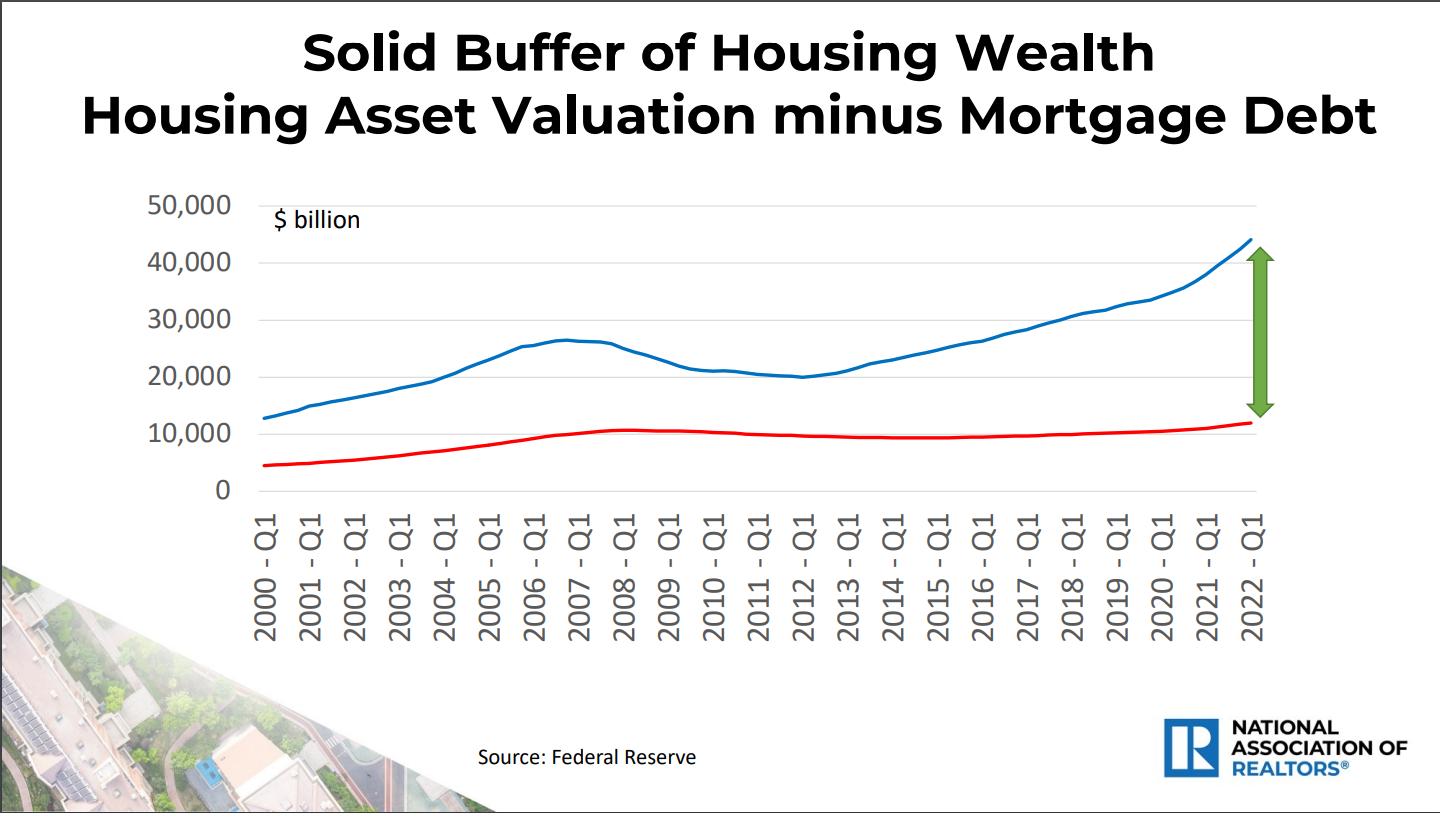
It’s also important to keep in mind the solid buffer between housing asset valuation and mortgage debt, which argues strongly in favor of buying a home. That buffer is one of the key reasons why real estate is still the best long-term investment.
What information from this forecast will you add to your conversations with clients this week?