

THE YOUTUBE PLAY:
- Name the fear, then take it back. “Aren’t Selling” earns the impression, “But Others Are” earns the click.
- Put the winner three blocks away. Proximity turns market news into envy, and it’s the biggest split on the board.
- Show both feelings in one frame: a dark row of houses, one with the lights on, an arrow pointing at it.
- Promise a count, then sort by condition, never by town.
- Count both lists down to price. The fear resolves into the one thing your seller controls.
- Run it again next quarter. Fear formats decay fastest, so bank the wins now.
From Denver and Dallas to San Diego, Atlanta and Honolulu, real estate agents are publishing versions of the same YouTube video title:
“Why These [Market] Homes Aren’t Selling… But Others Are.”
The thumbnails look similar, too. The agent stands on one side. A row of dark homes fills the other. One house has its lights on, usually with a yellow arrow pointing directly at it.
The format may be repetitive, but it is working.
This week, I used 1of10.com to analyze 18 versions across 18 real estate YouTube channels. Together, the videos generated more than 310,000 views, and the median video received roughly three times the channel’s typical view count. A Denver video generated 31,581 views on a channel that normally averages around 1,500 (a 20.7-times increase).
Done correctly, this is not just another housing-market update. It is a pricing conversation, a demonstration of local expertise and the beginning of a listing presentation, all delivered before the seller ever contacts the agent.
Here is why the format is working and how to build a version for your own market.
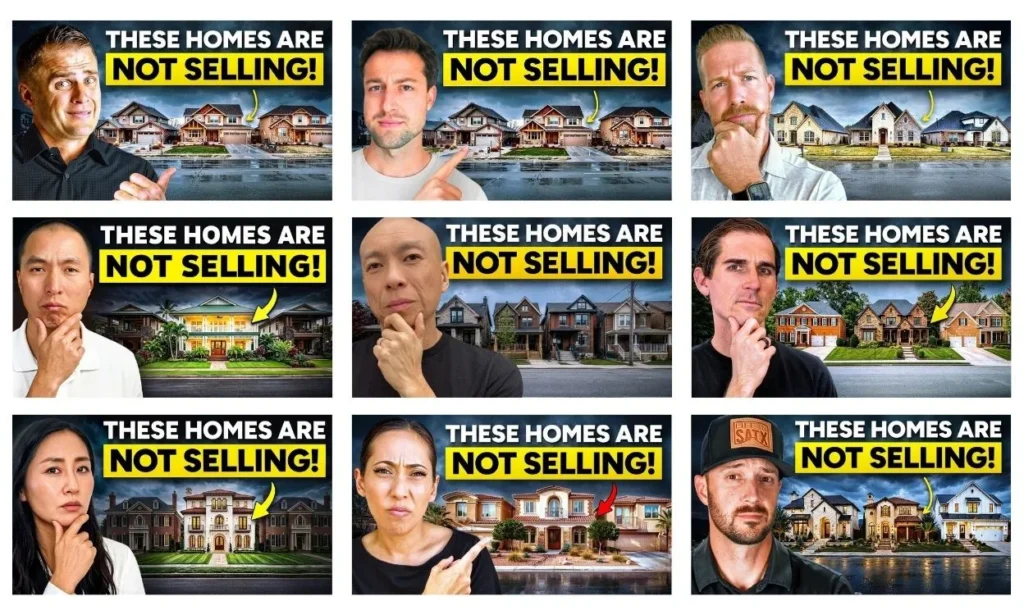
Denver, San Diego, Dallas, Honolulu, Toronto, Atlanta, Orange County, Las Vegas, San Antonio.
Nine channels, one frame: agent left, dark street right, arrow pointing to one house.
What is the “Aren’t Selling” format?
The “Aren’t Selling” format is a real estate video built on fear and FOMO in that exact order. It names the categories of homes failing to sell in one local market, then names the ones still moving fast.
This whole thing is engineered so a seller watches, wondering which list they’re on.
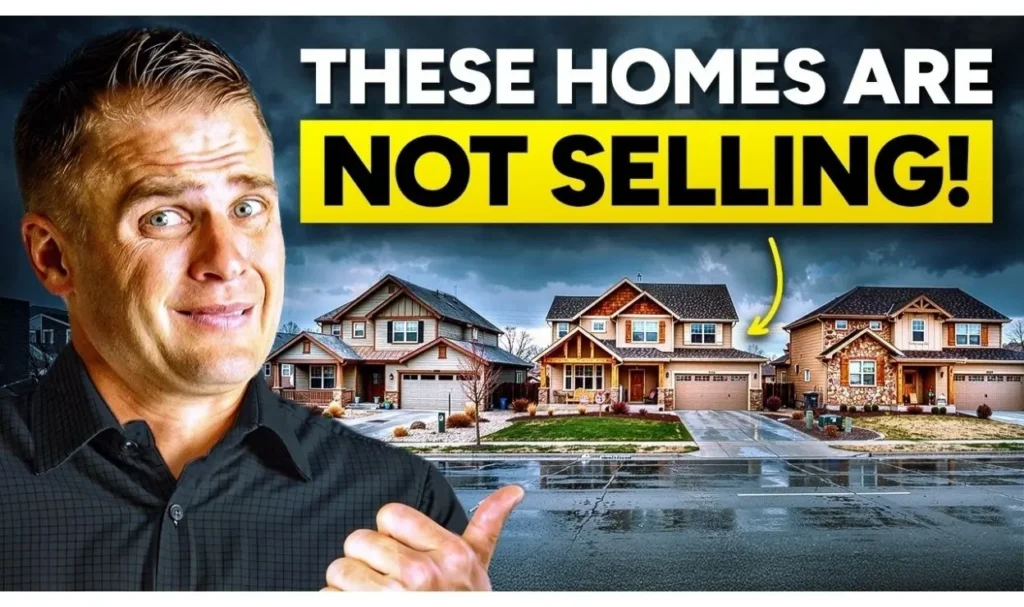
Both feelings in one frame. Storm sky and dark windows carry the fear.
The one lit house is somebody else winning, on your street, this week. The arrow makes sure you look at them.
Does the “Aren’t Selling” format work?
Eighteen videos, eighteen channels, 310,855 views between them. The median video beat its own channel average by 3.05x.
- Denver, CO: 20.7x (Subs: 7.1K, Views: 31,581, Length: 23:43)
- San Diego, CA: 9.6x (Subs: 2.1K, Views: 26,505, Length: 12:00)
- Dallas, TX: 7.1x (Subs: 60.8K, Views: 58,307, Length: 19:10)
- Honolulu, HI: 5.2x (Subs: 3.8K, Views: 12,849, Length: 26:24)
- Toronto, ON: 4.8x (Subs: 2.4K, Views: 4,558, Length: 12:55)
- Atlanta, GA: 4.5x (Subs: 3.0K, Views: 43,629, Length: 18:30)
- Orange County, CA: 3.6x (Subs: 4.0K, Views: 21,293, Length: 18:08)
- Las Vegas, NV: 3.3x (Subs: 6.4K, Views: 26,803, Length: 16:39)
- San Antonio, TX: 3.3x (Subs: 27.0K, Views: 31,503, Length: 19:12)
- San Diego, CA (2nd): 2.8x (Subs: 12.6K, Views: 11,061, Length: 12:18)
- Columbus, OH: 2.4x (Subs: 5.5K, Views: 6,187, Length: 20:56)
- Omaha, NE: 1.7x (Subs: 8.1K, Views: 2,122, Length: 8:07)
- Richmond, VA: 1.6x (Subs: 6.8K, Views: 4,416, Length: 13:48)
- Houston, TX: 1.6x (Subs: 11.0K, Views: 13,756, Length: 15:54)
- Seattle, WA: 1.5x (Subs: 7.9K, Views: 11,477, Length: 30:07)
- Jupiter, FL: 1.1x (Subs: 3.4K, Views: 1,855, Length: 14:00)
- Orlando, FL: 1.0x (Subs: 11.5K, Views: 1,619, Length: 14:46)
- East Volusia, FL: 1.0x (Subs: 3.0K, Views: 1,334, Length: 27:48)
The outlier score is how far the video beat that channel’s own recent average. Dallas got the most views on the board and still only scored 7.1x, because that channel already averages 8,200.
Why does the “Aren’t Selling” title get the click?
The title works in two parts:
- “These homes aren’t selling” names the fear. A seller immediately wonders whether their property falls into that category.
- “But others are” introduces the tension. If buyers are still purchasing homes nearby, the seller cannot blame the entire market. Something must separate the listings that move from those that sit.
Fear earns the viewer’s attention. The contrast gives them a reason to click.
Compare these two titles:
- Why These Chicago Homes Aren’t Selling
- Why These Chicago Homes Aren’t Selling… But Others Are
The first is simply bad news. The second introduces two groups, and the viewer is wondering which group their home belongs to. That unanswered question can hold their attention for the next 15 minutes.
The reason this works is fear alone is not a strategy. If your video only tells homeowners that the market is slow, you leave them anxious without giving them anything useful to do.
The stronger promise is that some homes are still selling, and you are going to explain why.
Why does the one-lit-house thumbnail stop the scroll?
The thumbnails show an agent on the left and three similar homes on the right. Two homes were dark. One had warm lights glowing through the windows, usually with a yellow arrow pointing toward it.
It stops the scroll because the image tells the same story as the title: these homes are struggling, but this one is winning.
If you want to recreate it, keep the design simple:
- Place your cutout in the left third with a skeptical or concerned expression.
- Show three similar homes on the right.
- Darken or desaturate the overall scene.
- Light one home with a warm glow.
- Point a yellow arrow toward the winning home.
- Use a short text block such as “THESE HOMES ARE NOT SELLING.”
- Remove the brokerage logo, phone number, address and other clutter.
Remember that your expression matters here. Smiling next to the words “not selling” makes you look like you are celebrating someone else’s problem. Your role is to be the guide who understands the problem, not the person enjoying it.
The homes should also remain generic. Do not place a recognizable listing beneath a giant “NOT SELLING” label. Save the specific examples and full context for the video.
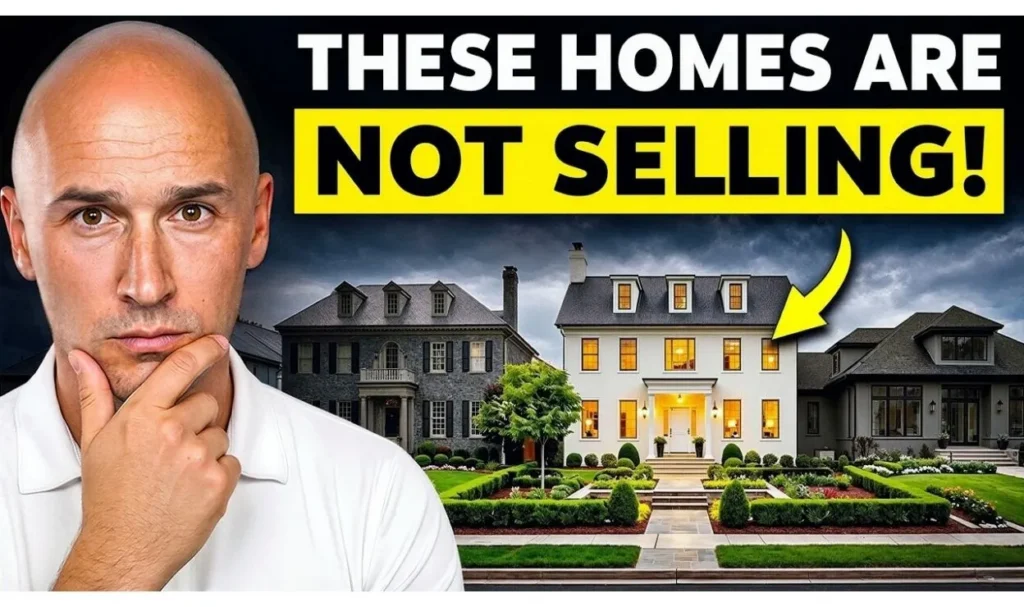
Here’s an AI prompt to recreate the thumbnail:
- 1280×720. My image cutout in the left third, hand on chin, skeptical, drop shadow behind me.
- Right two-thirds: three similar suburban houses on a wet street, shot straight on, desaturated.
- Dark storm sky. Keep the wet-road reflections.
- Light the middle house only: warm glow in the windows. It should read as the one house where life is going well.
- Top right: THESE HOMES ARE in white condensed caps, NOT SELLING! in black on a solid yellow bar.
- One thick yellow arrow curving from the bar down to the lit house.
- No address, town name, logo, phone number or price. Check it at phone size and in dark mode.
How to Structure the First 60 Seconds
The opening of your video should move quickly. Homeowners clicked because they want to know which homes are struggling and which are still winning.
Do not make them sit through your résumé, company history or a 30-second animated logo.
Instead, use these six beats:
1. Start with the home that sat
Open with a specific local example: how long it remained active, whether the seller reduced the price and what eventually happened.
2. Introduce the nearby winner
Show a comparable property that went pending quickly, received multiple offers or sold above asking.
3. Establish the proximity
Tell viewers how close the two homes are: three blocks apart, in the same subdivision or 15 minutes down the road.
4. Reframe the market
Explain that the entire market is not frozen. It is divided between homes buyers will act on and homes they believe they can wait on.
5. Promise a specific list
Tell viewers exactly what they will learn: conditions that make homes sit in your market (i.e., high HOAs) vs. conditions that allow for quick sales
Thirteen of the 18 videos made a numbered promise. Those videos achieved a median of 3.3 times their channel average, compared with 1.7 times for the videos that did not.
6. Give viewers a yardstick
Briefly explain the metric you are using, whether that is days on market, sale-to-list-price ratio, months of inventory or the number of offers received. Keep this short. The metric establishes credibility, but it is not why viewers clicked.
Is fear-based packaging safe to run?
Yes, as long as the fear points at something the viewer can fix. That’s the whole ethical line here, and it’s also the legal one.
Look at what’s under the words NOT SELLING in the winners:
- High HOA dues
- Fragile condo associations
- Tight financing
- New construction next door
- Deferred maintenance
- Roofs with under five years left
- Price bands
Every one is a condition with a remedy, which is why thirteen of the eighteen never say “worst” once. The format doesn’t need a villain.
How to Create Your Own Version
Here’s the complete play:
- Choose one submarket. A citywide comparison can become too broad. Start with one neighborhood, property type or price range where you have enough activity to identify a pattern.
- Find one home that struggled. Look for a listing that remained active for more than 60 days, required multiple reductions or expired without selling.
- Find one nearby home that moved. Ideally, this property went pending within a week, received multiple offers or sold above asking.
- Document the difference. Compare condition, presentation, financing, HOA costs, competition, price per square foot and the original list price.
- Open with both results. Present the struggling home first, followed immediately by the nearby winner.
- Promise a numbered breakdown. Five categories is enough if your data supports five. Do not manufacture additional categories.
- Count down to price. Let pricing become the conclusion supported by the preceding evidence, not a lecture delivered in the opening minute.
- Aim for approximately 12 to 16 minutes. In this sample, videos under 13 minutes slightly outperformed those longer than 20 minutes. Treat that as a directional signal, not an absolute rule.
- End with a seller-focused call to action. Invite homeowners to request a property-specific analysis to determine which side of the market their home is likely to land on.
- Update the video quarterly. Replace the listings and statistics as your local market changes.
Borrow the Format, Not the Entire Script
There’s already evidence that agents are copying this concept almost word for word. Several videos used nearly identical openings, phrases and numbered structures.
A proven format can give you a starting point, but the template is only the floor. Your ceiling comes from the work another agent can’t copy: a real home that struggled, a real home that won, and a sharp explanation of what separated them.
The format itself will eventually lose some of its novelty. In this sample, videos published before April 2026 recorded a median performance of 3.9 times their channel averages. Those published from April forward fell to 2.6 times. That doesn’t mean the idea is dead.
A seller is always worried that their home will sit. Another homeowner nearby is always getting a better result.
The agent who can explain the difference, with names, numbers and local evidence, becomes someone worth calling.