
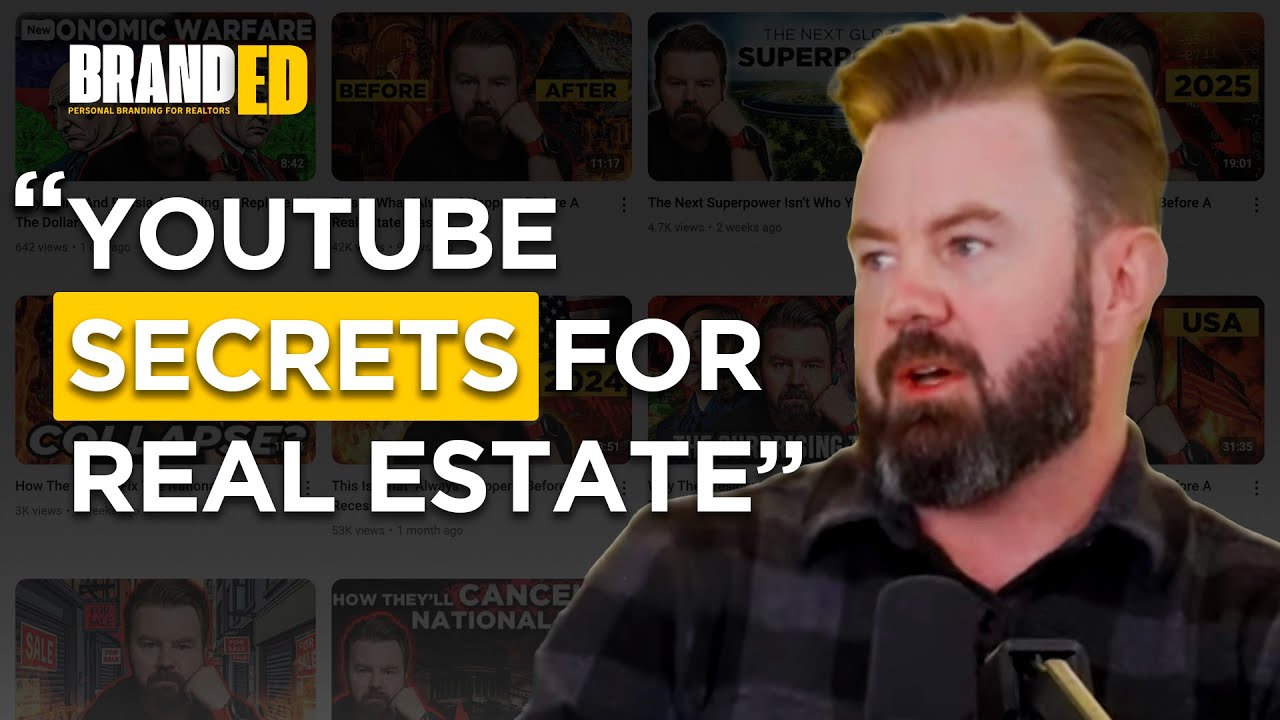
If you’re a real estate professional with a YouTube channel—or you’d like to create one—this week’s episode of Branded is one you cannot afford to miss.
Host Brad McCallum sat down with Nolan Matthias for a conversation that centered on YouTube channels, sharing insights that apply specifically to real estate agents.
Starting with his background and what led Matthias from business school to real estate, the conversation went from philosophical to tactical before wrapping up with a few key takeaways.
To give you a hint of what’s to come, Matthias and McCallum talk about branding on YouTube—including what it takes to build brand recognition, what it means to have a “great brand,” and what your real estate brand is ultimately all about.
Read on for the highlights. Then make time to watch the full conversation.
Define your audience
Using client avatars to get clear on the audience you want to serve with your content is not a new thing. Matthias often uses a neighbor couple as his ideal client avatars, addressing them in his videos and answering their questions. On the one hand, he thinks about his audience’s wants, fears and motivations.

But the other side, and this is the most important piece, is ‘Who do you need to be to serve the person that you want to serve?’
As you’re working through the process of finding out who you need to be, you’ll no doubt be tempted to delete content that isn’t getting views or isn’t a good fit for your brand. But as McCallum noted, the algorithm will filter out low-quality content for you—meaning no one is going to see it anyway.
The real danger is when you keep putting out content for the wrong audience.

If it’s good content but it’s for the wrong audience, you might get the views, you might get the followers, you might get all those signals of success, but it doesn’t actually show up in your bank account.
The Biggest Mistake Agents Are Making with Instagram and TikTok
Matthias went on to address something he sees a lot of entrepreneurs doing with their content. He went so far as to call it the “biggest mistake” people are making on IG and TikTok.
Now here’s the biggest mistake I think people are making with Instagram and Tik Tok, and that’s treating them like push platforms. So, in other words, I’m going to make my dancing, pointing video, and I’m going to push it out there [and] I’m going to hope the phone rings. And Tik Tok and Instagram are both set up exactly the same way; they are the best platforms for you to gather information on your prospective clients and then network with them—which means you’re talking to them, not just putting out content and hoping people respond to you.
McCallum then pointed out that, when it comes to conversations that lead to business, Instagram has a clear advantage over TikTok.
In fact, I would argue that that’s the reason why Instagram is so incredibly valuable in comparison to Tik Tok is purely the DM messaging platform… People go to the comments way more on Instagram than they do on Tik Tok; they go to the DMs way more than they do on Tik Tok. It’s a different viewer…you’re in a different mindset, I think, when you’re on there.
Matthias doubled down, recommending a specific ratio of Reels creation to engaging with your Instagram audience.
Absolutely! And I’d go a step further than that…if you’re spending an hour making a Reel on Instagram, you need to be spending four hours in the DMs with people, talking to people. It’s networking, it’s outreach…it’s crazy because I’ve been working with a bunch of people doing consulting work for people in the fitness industry. And what they do, relative to what the real estate industry does, just blows my mind. Because they are literally using Instagram as a platform solely for attracting people who are like-minded and then communicating and building relationships with them. The content is secondary to them.
7 Things to Consider when Launching Your YouTube Channel
Asked what he recommends to agents just getting started with a YouTube channel, Matthias offered a generous mix of tactics and truths to keep in mind.
#1: Make what is already working better
Too many creators get stuck thinking, “Oh, someone else is already doing that,” when they could easily turn that into inspiration, thinking, “Awesome! Someone else is doing that, and they’re killing it! I must be on the right track. So, how do I make my version of it irresistible to my audience?”
Absolutely! And I’d go a step further than that…if you’re spending an hour making a Reel on Instagram, you need to be spending four hours in the DMs with people, talking to people. It’s networking, it’s outreach…it’s crazy because I’ve been working with a bunch of people doing consulting work for people in the fitness industry. And what they do, relative to what the real estate industry does, just blows my mind. Because they are literally using Instagram as a platform solely for attracting people who are like-minded and then communicating and building relationships with them. The content is secondary to them.
#2: Your analytics can tell you how often to post
A big question in content creation circles has to do with posting frequency or cadence. In other words, “How often should I post?”
The problem? There’s no one correct answer to that question. It depends on the type of content you’re creating. On the flipside, the posting frequency you choose can help you identify the kind of videos that will help your channel grow.
If you’re going to make a very small amount of videos like one a week or one a month, they need to be like Brad McCallum-level production. If you’re going to make lower quality production videos, like what I make—which is like a flip a switch, camera comes on, super low lift on the editing—then you’ve got to make more content. But the algorithm and the analytics will tell you exactly what your cadence should be. Because…you’ll see your views go up and then you’ll see them drop. And then you’ll see them go up, and when they drop that’s when you should be releasing videos.
#3: Focus on the right things
Granted, this is a topic we’ve covered before—for good reason. If you’re holding off on posting YouTube videos until you’ve got the “right camera” or the “right lighting” or until you’ve built up your video editing skills (or hired someone to take that off your plate), you’re focusing on the wrong thing.
Yes, video quality does matter, and we’re not telling you shouldn’t invest in a good camera and good lighting equipment. But you don’t need to have everything just so before you get started.
I’m a firm believer, especially in the real estate space…worrying about what camera you have, what lights you have, and how good your editing is is the worst thing you can focus on. Just focus on knowing who your audience is, what the message they need to hear is, and speaking directly to them when you’re making your videos. And if you can do just that, it doesn’t matter if you film it on an iPhone. The only thing that really matters in my mind is that you have good quality audio.
#4: Give your YouTube audience (one per channel) five videos to start with
This is a big one, and it’s a two-parter. First of all, when you’re just launching the first (or only) YouTube channel for your real estate brand, start with 4-5 videos.
Never launch one video and then hope and pray that it gets views. What you want is to send positive signals to the algorithm—keeping in mind that YouTube’s algorithm is not the TikTok and the Instagram one, which is based on views. YouTube’s algorithm is based on AI; it has been since 2013… Google’s been using [AI] for years—so has Tesla, so has SpaceX. So, when you think about the algorithm you have to think about the audience, because the way the AI is designed is to think about what an audience would want to see next. So, when you start a new channel, you can’t just give people one video and hope; you actually need to think about what’s the video that I think is going to get the most views of all the ideas that I have. But then you also need to give them two or three videos—ideally four videos so you’ve released five videos on the first day…You want to give your audience more of your content to watch. And you want to think about ‘If they watch this video, what would they watch next, and what would they watch after that?’
If you can get your viewer to watch two, three, or more of your videos right off the bat, that “sends really positive signals to the algorithm,” which is then more likely to suggest your videos to more people. The more of your videos people watch, the more likely they are to subscribe to your channel and watch more content as it goes live.
Of course, with that comes a caveat…
And here’s the really important part: Never, ever, when you’re launching a channel, especially if you’re in real estate, push it to Instagram or Tik Tok. Because if you’re a real estate agent and you have an Instagram or Tik Tok account, it’s probably being followed by mostly Realtors. And if a bunch of Realtors jump into that content and start watching it, you’re sending the signal to the algorithm that Realtors are your audience. And you’re gonna end up fighting that for the next six months…
#5—Give the YouTube algorithm time to find its own audience
If your email list is full of people who are a good fit for your YouTube audience, it makes sense to steer them in that direction. But there are a few things to keep in mind before you send them a link in your next email.
Let’s say you have an email list of your clients. Definitely wait 5 days, let the algorithm…find its own audience. But then, you know, a week after you release a video, if you know that you have the exact right audience for that video, definitely send them. But don’t send them to the video; send them to the channel page…with a link that automatically asks them to subscribe. And then they can pick which of the five videos you’ve created that they actually want to see. And maybe it’s the one that you’re suggesting they look at, but maybe they want to look at one of the other ones first, and that’s all positive signals.
Another thing to avoid is posting content for a different audience to the same YouTube channel.
[Y]ou want to make sure that the content that you’re putting out is actually getting seen by the audience that wants to watch it. And I have some experience with some guys in the fitness industry…guys that have 300,000 subscriber YouTube channels that tried to put their podcast on the same YouTube channel. What happened is the content that the audience wants is either going to be the normal content or the podcast content. And whatever’s the more prominent audience, those videos—the ones that are designed for that audience—are going to step on the other videos.
#6: Audience overlap and clustering
What can happen with different YouTube audiences is when one of them watches one video because of their interest in a specific thing, while another watches a different but somewhat related video on another channel. But then, as both audiences skim over the suggestions on the right-hand side of the page, they may click on the video watched by the other audience. Their interests overlap.
The overlap is the part where I think it gets kind of cool… The people that watch my listing tours, a small portion of them would like to also learn how to create content for themselves because they’re Realtors as well. And then maybe a small portion of the people that want to learn how to create content on Branded like Brad and our tutorials and some of that stuff might also be the kind of people who’d want to listen…
Audience overlap can lead to something both Matthias and McCallum agree is pure magic for YouTube creators. It’s called “clustering.”
So, when you have all these channels with different creators that are growing, and they’re growing together, and then you think about that from the perspective of ‘Well, what if I created five channels? Well, now I’ve got a podcast channel, I’ve got Branded like Brad and I’ve got Brad McCallum’s main YouTube channel.’ Well, if the algorithm is searching for a certain audience with the podcast and then searching for a certain audience with the Branded like Brad Channel, and there’s an overlap in the audience, the algorithm, the AI is smart enough to know that if they’re watching this channel, they’ll want to watch [that] channel, and they’ll serve it up for both.
Matthias did include a caveat, saying, “Don’t go and create a whole bunch of channels just because.”
Start with one. Once you know how much of your time and energy it takes to keep one channel going strong, you’ll know whether you’ve got the bandwidth to take on another—or at least to get it started.
#7: Branding is more personal than tactical
Finally, McCallum summed up his key takeaways from his conversation with Matthias. One of our favorites has to do with what your real estate brand is ultimately all about.
The part that agents I think lose out too often on is they’ll go after the tactics and then they forget that their brand is that emotional connection that they’re making with those people—that part of them that says, ‘Hey, I’m like you. I understand your worries and your fears. But here’s the thing: from my perspective there’s a couple of things you could consider…
So, if you can’t get that piece of it you end up losing the personal brand maybe you gain some views, but I find that if your content is not something you’re passionate or really interested in, you’re going to end up creating great content that gets views, but you’re going to get burnt out.
That clearly resonated with Matthias, who shared how he learned the same with his own channel.
I’ll be honest and vulnerable on this…probably one of the biggest problems with my channel was that connection to the audience. I was just like ‘facts, facts, facts,’ and what I found was when I started talking more about my own personal experiences—not making the video about me, making the video about them and then talking about how I’ve been in that situation—yeah, that’s when things really started to take off.
Watch the full conversation for more.