

Key Details:
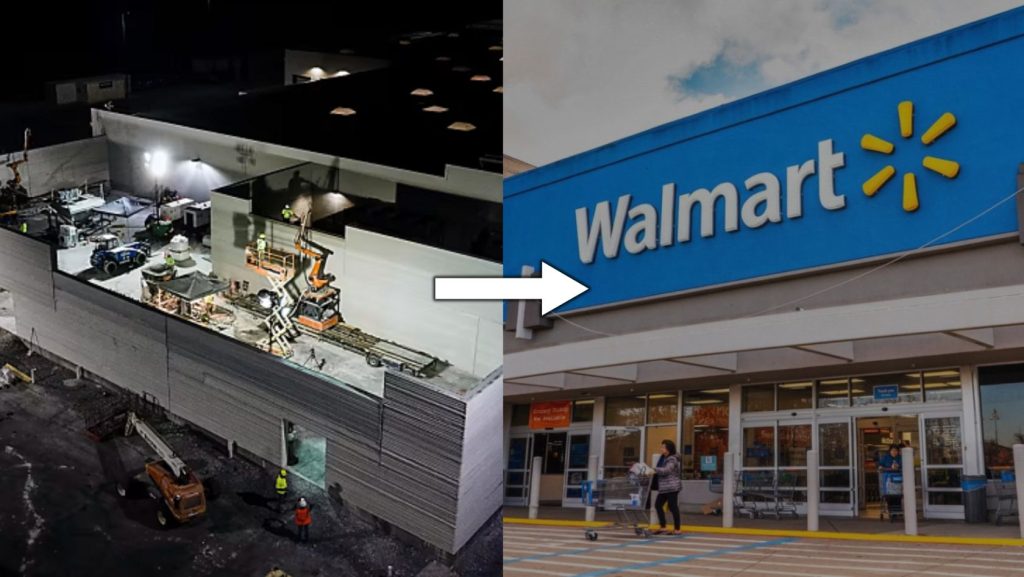
- Retail giant Walmart hired Alquist 3D to build an 8,000-square-foot expansion to its Supercenter location in Athens, TN, designed for storing online purchases for pick-up and delivery.
- The new building is one of the largest 3D-printed commercial structures in U.S. history, standing 20 feet high, which in itself is a major achievement for 3DCP (3D concrete printing) technology.
- Despite unanticipated challenges that delayed the building by weeks, Walmart hired Alquist 3D for another project in the same vein. The Athens, TN, building is the first of over 200 additions planned by the multinational corporation.
3D-Printing for home construction is still a fairly new technology—and it isn’t necessarily the cheapest route to putting more homes on the market.
That said, some in the commercial sector are looking at the technology with fresh eyes as a potential go-to for future retail building projects.
A recent CNBC interview shed some light on a partnership between Alquist 3D and American retail giant Walmart to create one of the largest 3D-printed commercial structures in U.S. history.
Alquist founder and chairman Zachary Mannheimer shared some of the difficulties involved in the first project—an 8,000-square-foot expansion to Walmart’s Supercenter location in Athens, TN—as well as his outlook on future 3D-printed additions.
Walmart hired Alquist 3D for the new addition, planned as a storage facility for online order pickup and delivery.

This partnership started among several different groups—FMGI, an amazing general contractor we’ve worked with, and of course, Walmart—to print the largest commercial structure there is in America. This was not an easy task. Lots of things were learned along the way. But what we have now is a major commercial structure. Another major achievement of this is to go up 20 feet. That hasn’t happened before with something this size. So, we learned a ton on this project, and we’re excited to do the next one.
Watch the interview here:
What gave Walmart the idea to 3D-print an 8K-square-foot addition?
An article on 3Dprint.com provides some backstory for Walmart’s decision to hire Alquist 3D for its Athens, TN, Supercenter addition.
About seven years ago, in 2017, global enterprise Deloitte published a report on innovations in commercial real estate (CRE), listing “five themes that CRE owners should consider integral to their business strategy.” One of those themes was 3D printing.
Now, it looks like additive construction (AC) could finally be making inroads in the CRE sector.
So, what exactly is additive construction?
According to ScienceDirect:
“Additive construction represents the entire process of building a digital form (building design) from materials produced on-site (material science), which are then deposited according to a digital model (engineering).”
AC technology is often suggested as a potential solution to the U.S. housing shortage. Walmart’s Vice President for U.S. Construction, Mike Neill, wanted to see if 3D concrete printing (3DCP) could build their expansion more quickly and at lower cost.
Ultimately, he was intrigued enough by the new technology to give it a try.
“Walmart is always looking to innovate and leverage developing technologies, and as we dug deeper into the opportunities within 3-D concrete printing, we decided it was a direction worth exploring.”
Challenges and Opportunities in 3-D Printing
As a fairly new construction technology, 3D printing still has some kinks to work out, as the company’s leaders are quick to acknowledge.
Walmart’s first 3DP expansion project faced delays due to Tennessee’s scorching summer heat and humidity, which caused the building material to heat up too quickly, causing clogs and slowing construction.
So despite using 3D printing, construction ran weeks behind schedule. And due to the temperature-related complications, the final cost was similar to traditional building methods.
In the CNBC video, Mannheimer shows an image of the builders working at night, which was the only time they didn’t have to contend with the Tennessee heat (or at least not to the same degree).
Another obstacle that delayed construction was the difficulty of obtaining local building permits.
Venture capitalists have poured billions of dollars into 3D-printing startups, expecting breakthroughs in industries like semiconductors and aerospace.
Proponents of the technology believe it could alleviate the housing shortage in the U.S. by building homes more quickly and at lower cost. In fact, a Texas development of 100 3D-printed homes—the largest 3D-printed development in the U.S.—is currently under construction.
As of yet, though, few commercial real estate projects have been completed using 3D-printing technology, mainly due to its current inability to significantly improve upon the speed and cost of traditional construction.
Lessons Learned and Future Projects
Alquist 3D ran into several issues in the construction of Walmart’s addition, including:
- Incompatible materials
- Overheating
- Fast-setting material that left little (if any) room for error
As Alquist 3D CEO Patrick Callahan admitted, “There’s a number of things that we’ve learned.”
The Tennessee heat drove up the temperature of the building material, which created clogs, slowing things down—hence the switch to a nighttime construction schedule.
As the project progressed, however, and the company pivoted in response to those challenges, construction became more efficient. And while the final cost was not significantly lower than that of traditional construction, Walmart was satisfied enough to hire Alquist for another 3DP project.
Alquist 3D has had success with residential 3D-printed projects like working with Habitat for Humanity to 3D-print homes in Virginia. Those homes, outfitted with monitoring technology, outperformed traditional builds in indoor environmental quality.
Another project in Iowa was less successful, with temperature-related cracks in the building material leading to structural issues. Alquist ended up parting ways with that client.
Pete Evans, an assistant professor in industrial design at Iowa State University, summed up the lesson learned. He’s now working on a different project to assess whether or not 3D-printed homes are feasible in Iowa.
“That situation I think exposed the difficulty that 3-D construction printing is at today. There are complications around temperature, humidity, water, all kinds of environmental factors.”
Despite the challenges faced with their first 3D-printed storage addition, Walmart is planning over 200 similar projects using 3D-printing technology to test its viability for more efficient and cost-effective construction.