
Key Details:
- Failure to disclose costly issues with the house has become a more urgent problem
- Even agents are involved, some of them encouraging sellers to mislead buyers
- Thorough home inspections by a neutral party are more important than ever
Failure to disclose issues with houses for sale has become a more urgent problem with last year’s buying frenzy.
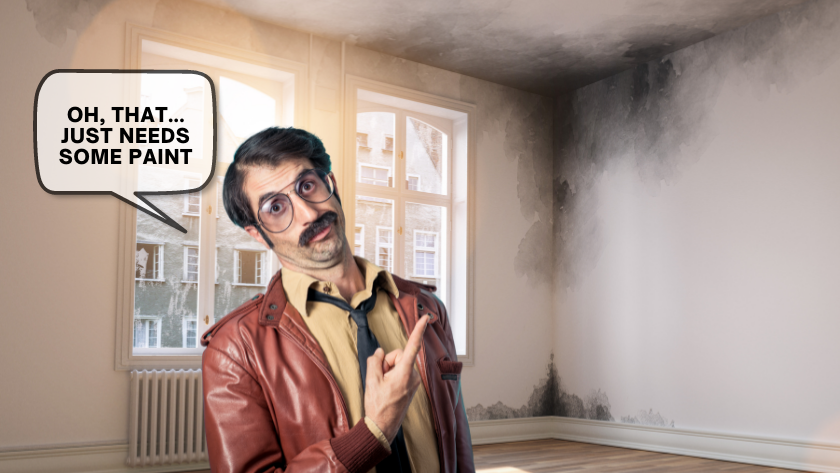
With so many buyers foregoing the home inspection to gain an advantage over the competition, sellers saw bids increasing by the day. Many didn’t want to scare buyers off with the truth about the house’s issues:
- Leaky pipes
- Water damage
- Termite infestation
- Moldy windows
- That funky smell in the basement
I mean, what house doesn’t have issues, right? Wink, wink, hush, hush.
On the other hand, not mentioning issues that cost money to fix can actually land you in court. And that goes double for real estate agents who encourage sellers to omit those pesky details in their listing descriptions.
A few stats on failure to disclose
Cinch Home Services surveyed homebuyers and home sellers on the kinds of property damage they’ve dealt with after purchasing a home.
The following stats are just a few of their July 2022 survey results.
- 95% of homebuyers find issues with the house after closing
- 60% of sellers admit to selling a home with an issue without disclosing it to the buyer
- 65% admitted to an issue that was worse than they made it out to be
- 74% of sellers admitted to hiding major issues with shoddy (attempted) repairs
Here’s the one that really burns: 77% of home sellers said their real estate agent was the one who encouraged them to mislead the buyer.
So, more than three-quarters of these sellers were encouraged by their agent to lie by omission to the buyer, leading them to believe the home had no serious issues. Of course, they discovered the truth after closing day.
Types of problems found after closing
A Cinch survey of 494 homebuyers and 476 sellers—conducted within the past year—revealed the following stats on the types of property issues buyers found after closing.
- Electrical – 88%
- Fixtures (lighting, etc.) – 58%
- Plumbing – 58%
- Exterior structures – 54%
- Leaks – 54%
- Basement – 52%
- Water damage – 46%
- Heating and cooling – 43%
- Exterior facade – 42%
- Mold or termites – 39%
- Major appliances – 34%
- Roof – 31%
- Foundation – 27%
The majority of problems found after closing (74%) were unpermitted repairs and upgrades—which often lead to bigger issues down the line.
The most common issues were electrical (88%), with fixtures, plumbing, and exterior structures next in line. And these are some of the most serious issues a home can have—issues the homeowner can’t afford to ignore.
Listing agents behaving badly
According to Cinch’s survey, of those sellers whose agents encouraged them to mislead the buyer (77%), the following reported exactly what behavior their agents encouraged:
- 58% — misrepresenting an aspect of the home
- 55% — concealing a known problem with shoddy/botched repairs
- 55% — withholding information about known issues
- 53% — only disclosing problems if mandatory
- 49% — engaging in miscellaneous unethical behavior
What about the sellers?
Cinch’s survey also assessed buyer perceptions of seller behavior:
- 74% report the seller made an effort to conceal a known issue
- 66% report the seller withheld information about a known issue
- 51% report the seller misrepresented an issue (as less serious)
- 46% report the seller outright LIED about a known issue
On the seller’s side, 74% admitted to concealing issues with shoddy or botched repairs, and 81% admitted to actions they believed others would probably consider unethical.
Failure to disclose can lead to lawsuits
Hiding known property issues from buyers is a common problem in real estate. But when a buyer discovers defects that were not disclosed by the seller or the listing agent, that buyer can sue both of them for misrepresentation.
Buyers in last year’s frenzied market were more likely to waive a home inspection in order to win bidding wars. And sellers, seeing those bids coming in, didn’t want to scare off buyers by disclosing known and expensive defects.
And some agents were more than happy to encourage the seller to keep quiet.
Failure to properly disclose can lead to misrepresentation claims, ranging from fraud to negligence and, in some states, innocent misrepresentation.
Rymarowicz cited a court case in which the agent was ordered to pay the buyer $170,00 for showing a “reckless disregard for the truth” by not disclosing a listing’s water damage.
Best practices to avoid a misrepresentation claim
Rymarowicz offers some best practices for agents to help avoid a misrepresentation claim due to a seller’s failure to disclose an issue (or multiple issues):
- Do NOT fill out a disclosure form on behalf of the seller
- Encourage the seller to disclose all known facts and defects—and to share ALL of them with the buyer
- Review the seller’s disclosure form to ensure they answered all the questions (truthfully)
- If the seller refuses to disclose a material fact or defect you’re aware of, you should disclose it to the buyer yourself as soon as possible
- Document everything — any information the seller has provided, such as answers to questions regarding the condition of the property,
- Keep any research you’ve done yourself on the condition of the property.
Also, be prepared to share your research with the buyer if your seller is unwilling to disclose costly issues you’ve discovered. Losing the deal will be far less costly to you both than dealing with a lawsuit for misrepresentation.
No one wants to work with an agent who’s been sued for misrepresenting defects that are expensive to fix and too serious to ignore.
Considering how challenging 2023 is likely to be for real estate agents—with 40% expected to leave the industry—here’s hoping we’ll see far fewer agents willing to mislead buyers or encourage sellers to do so.