Coaching in real estate has long centered around scripts, role play, and standardized training. But they’re often trained using the same frameworks, regardless of how they naturally communicate or process information.
Shilo’s latest launch, Signals, is designed to change that. The new feature uses AI to evaluate call recordings and build personality insights for more tailored coaching at the individual agent level.
Here’s how Signal works and what it means for agents and team leaders.
What Signals Is & How It Works
Signals is an AI personality assessment built for real estate agents that runs on real conversation data. It connects to an agent’s phone system and CRM, then analyzes weeks and months of call activity to understand how that agent actually communicates.
The system runs on a large dataset:
- 21+ years of analyzed talk time
- 7,000+ agents
- 3 million+ calls processed
Rather than relying on self-reported input, Signal looks at real conversations to build the profile.
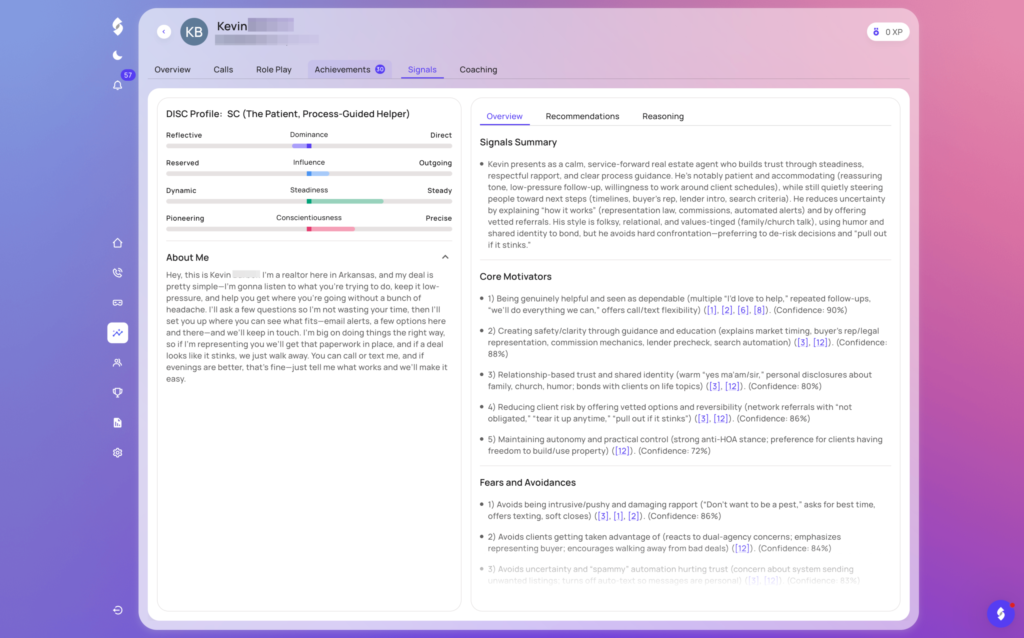
At the core is a DISC personality profile based on four behavioral dimensions (Dominance, Influence, Steadiness, Conscientiousness).
Each trait is mapped on a spectrum, so you can see how much of each shows up in an agent’s communication.
Source: Shilo.ai
Profiles also include a combined type that reflects how those traits work together.
Signals goes beyond trait labels and surfaces behavioral patterns pulled directly from calls:
- How the agent handles objections
- How they build rapport
- How direct or indirect they are in conversations
- How they respond under pressure
Each profile includes a plain-language summary that describes how the agent communicates and what kind of interactions they respond to. Every insight is tied back to specific calls and includes a confidence score based on the amount of data behind it.
Shilo CEO Justin Benson emphasized transparency in how those insights are generated:
“Transparency to data is core to who we are at Shilo because at a fundamental level it builds trust. We don’t suggest blind trust of AI in the same way we usually wouldn’t suggest blind trust of another person without the historical backdrop that proves trust. Each signal is given a transparent confidence score and backed by cited evidence from previous conversations you can click into and verify.”
How the Coaching Recommendations Work
Signals doesn’t stop at describing how an agent communicates.
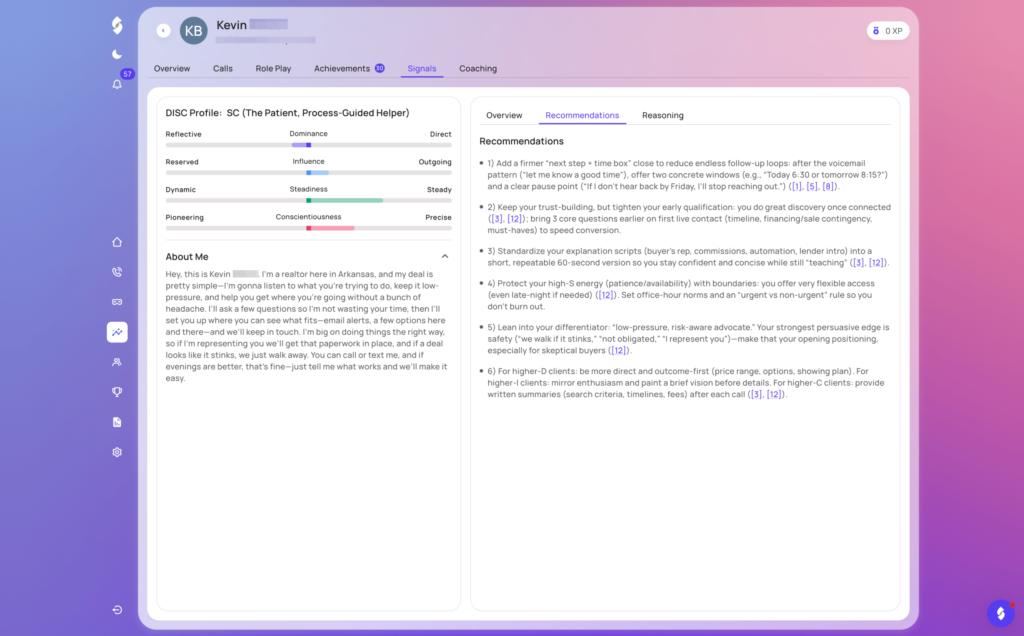
It uses that data to generate coaching recommendations that match how that agent actually processes information and takes action.
Each recommendation is built from two inputs: the agent’s personality profile and their real call behavior. The result is guidance that fits how that agent already operates, instead of forcing them into a script that doesn’t align with their style.
Coaching becomes more specific at the agent level:
- What to adjust in conversations
- How to structure follow-up
- How to approach different client personalities
- Where communication is breaking down
Source: Shilo.ai
The recommendations reflect real patterns in the agent’s calls, not generic advice pulled from a playbook. Two agents on the same team will get different guidance because they communicate differently and respond to different approaches.
Signals also adapts coaching based on who the agent is talking to. A high-D agent working with a high-I client may need a different approach than the same agent working with a more detail-oriented client.
The system accounts for those dynamics and adjusts recommendations accordingly.
As more calls are analyzed, the recommendations evolve. Coaching stays aligned with how the agent is performing in real time, giving team leaders a way to guide improvement without relying on guesswork or memory.
What This Means for Team Leaders and Agents
Coaching starts to match the person instead of the script. Team leaders can see how each agent communicates in real time. In addition, leaders can stay hands-on with more agents at an individual level.
For agents, the feedback reflects how they actually sound on the phone, not how they think they come across. That makes it easier to connect the feedback to real changes in conversations.
More consistent conversations across the team creates a clearer path from lead to appointment to deal. Coaching becomes part of the system instead of something that depends on how much time a manager has that week.
Availability and Access
Signals is now available to all current Shilo users at no additional cost.
New users can explore the feature through a personalized demo here, or review the full product walkthrough here.