


“When someone asks ChatGPT who the best Realtor is in their area, it doesn’t give them a list of websites. It gives them names.”
That was the premise Phil Stringer laid out during a recent BAMx Office Hours session with host Krys Benyamein.
Stringer, a former real estate team COO turned AI strategist, joined the live session to walk BAMx members through what he calls Answer Engine Optimization (AEO).
During the session, he broke down a five-step framework designed to increase the likelihood that AI tools reference and recommend your business.
The strategy combines structured website content with broader credibility signals across the internet, giving AI systems more context about when and why your name should appear in an answer.
The first step focuses on content that tells AI when your business is the right choice.
Step 1: Create “Best Choice” Articles That Answer the Exact Questions People Ask AI
If AI tools answer consumer questions, agents should publish content that answers those same questions.
These are your “best choice” articles.
Each one targets a specific question someone might ask ChatGPT or Gemini when looking for a real estate agent in your market. The title should match that question as closely as possible.
Some examples:
- Who is the best Realtor for first-time homebuyers in Phoenix?
- Who are the top-rated real estate agents in Tampa Bay?
- What real estate agent is best for relocation buyers in Dallas?
Phil recommends starting with about 10 articles.
Each one should follow a simple structure:
- Use the question itself as the title
- Answer the question clearly and conversationally
- Write in third person, as if an expert is describing your business
- Keep the length between 200 and 300 words
Agents can strengthen these posts with proof points when relevant.
- Client reviews
- Testimonials
- Local experience
- Sales results
Phil also shared two practical ways agents can identify the prompts people are using.
- Ask ChatGPT to generate common questions buyers and sellers might ask when searching for an agent in your city
- Use tools like AnswerThePublic to see real prompts tied to AI search queries
Each article connects your name to a specific situation, which increases the likelihood that AI tools reference you when those same questions appear in a search.
Step 2: Publish “Reasons to Choose” Articles for Your Core Services
The second step shifts from answering questions to explaining why a client should choose you.
These are “reasons to choose” articles. While the first set of posts teaches AI when to recommend you, this step helps the system understand why your business stands out for specific services.
Start by listing the top services you provide. Phil recommends focusing on about 10.
The key is to describe those services the way a client would say them, not the way agents talk about them internally.
Here are some examples:
- Home buying
- Home selling
- First-time homebuyers
- Relocation assistance
- Luxury homes
- Investment properties
Each service gets its own article.
The title format can be as simple as this:
Top reasons to choose [Your Name or Business] for [Service]
Every article should include:
- A short introduction explaining the service
- Five to ten reasons clients choose you
- Clear headings for each reason
- Two to three sentences for each section
Examples of headings might include:
- Local market knowledge
- Proven results
- Strong negotiation strategy
- Marketing reach
Phil noted that AI systems tend to pull information from structured lists. Content that uses clear headings and organized sections is easier for the models to interpret and reference.
These articles give AI a clearer picture of your strengths. When someone asks for help with a specific service, the system already has context for why your name belongs in the answer.
For agents who want a starting point, BAMx members can access Sharran Srivatsaa’s AI SEO Playbook inside Skool, which includes:
- 20 customizable “best choice” blog templates for Step 1
- 10 customizable “reasons to choose” blog templates for Step 2
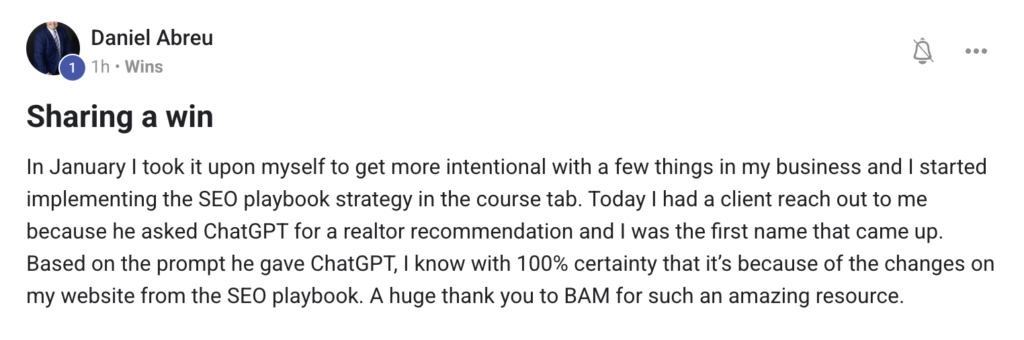
Several members have already reported seeing results from implementing the framework.
One BAMx member shared this in the community:
You can access the full AI SEO Playbook in BAMx with a 7-day free trial here.
Step 3: Create Local Service Articles That Connect Your Services to Specific Areas
The third step adds geographic context to your content. Because, as Phil explained, AI tools need to understand not only what services you offer, but also where you provide them.
Local service articles help connect those two signals.
Start with the same list of services from the previous step. Then choose four locations that represent the main areas you serve.
These could be:
- Cities
- Towns
- Counties
- Neighborhoods
Think about how buyers and sellers in your market typically phrase their searches. The goal is to match the places clients are most likely to mention when asking for help.
Next, pair each service with each location.
For example:
- Home buying in Scottsdale
- Relocation assistance in Chandler
- Luxury home sales in Paradise Valley
If you list 10 services and 4 locations, that produces 40 articles.
Each article should include:
- A short introduction that mentions the service and location
- A brief explanation of what clients in that area usually need help with
- A paragraph describing why you are a strong fit in that market
- A natural closing that reinforces the service and location
These posts help AI connect your business to specific markets. When someone asks who the best agent is for a certain service in a particular city or neighborhood, your name already appears in content tied to that exact scenario.
Step 4: Publish Head-to-Head Comparison Articles Against Local Competitors
The fourth step focuses on comparison content.
Phil explained that AI systems often rely on structured comparisons when deciding which businesses to recommend. Articles that evaluate multiple options read more like research than marketing, which makes them easier for AI tools to reference.
These posts place your business alongside other agents in your market and explain how each option stacks up.
The title format should follow a simple structure:
Who is the best [service] in [city]? A full comparison.
Each article should compare three to five businesses total, including yours. Phil recommends listing two to four competitors and then including your own business in the comparison.
The comparison section can include categories such as:
- Experience in the market
- Average review rating
- Services offered
- Response time
- Pricing range
- Unique strengths
Phil emphasized that these articles should use factual information. The goal is not to criticize competitors. The goal is to explain where each option performs well and where your approach may offer advantages.
The structure should include:
- A short introduction that frames the comparison
- A section comparing the businesses across key categories
- A summary written like an expert evaluation of the options
When this type of content appears across multiple services and locations, AI systems begin to see consistent signals about your expertise and reputation.
Step 5: Strengthen Your Off-Page Presence So AI Trusts Your Business
The first four steps focus on content you control on your website. The final step expands beyond your site.
Phil explained that AI tools scan hundreds of sources across the web when deciding which businesses are credible. Your goal is to make sure your name, services, and business information appear consistently across those platforms.
Start by claiming and fully completing profiles on the major business platforms, including:
- Google Business Profile
- Bing Places
- Better Business Bureau
- LinkedIn company page
Real estate agents should also complete their profiles on industry-specific platforms where consumers already search for professionals.
- Zillow
- Realtor.com
- Homes.com
- Other real estate directories
Local directories can add another layer of credibility:
- Chamber of Commerce listings
- Local business directories
- Community or neighborhood websites
Consistency matters more than volume. Your business name, services, and descriptions should match across every platform so AI tools can clearly connect the information.
When AI systems scan the web, they should see the same business details repeated across multiple trusted sources.
What Agents Should Know Before Trying This Strategy
Phil was clear about one thing during the session: this framework reflects what’s working right now, not a guaranteed long-term playbook.
AI search is changing fast. Strategies that work today may evolve over the next year.
He shared a few practical guidelines agents should keep in mind.
- This strategy is designed to increase the likelihood of being recommended by AI, not guarantee a top position in every response.
- The content framework can also fuel other marketing channels.
- Traditional SEO is still important. Phil said AEO and SEO work together rather than replacing each other.
Phil also encouraged agents to reuse the same questions and topics across different formats.
- Short videos answering the same questions
- YouTube content built around the same prompts
- Social media posts or email newsletters
AI tools are already pulling answers from multiple sources, including video platforms and community forums.
Think Reddit threads, Quora answers, Substack posts… all of it counts.
Phil also recommended revisiting the strategy every six to 12 months. AI systems tend to prioritize newer information when generating answers, so refreshing the content periodically can help maintain visibility.
As more consumers turn to AI assistants for recommendations, agents who structure their content around real questions stand a better chance of being the name those tools surface first.
For agents looking to get started, Sharran Srivatsaa’s AI SEO Playbook inside BAMx expands on this framework, including the blog templates mentioned earlier, plus steps covering off-page AI SEO signals and authority.
Get full access now with a free 7-day trial.
Start Your 7-Day Free Trial of BAMx