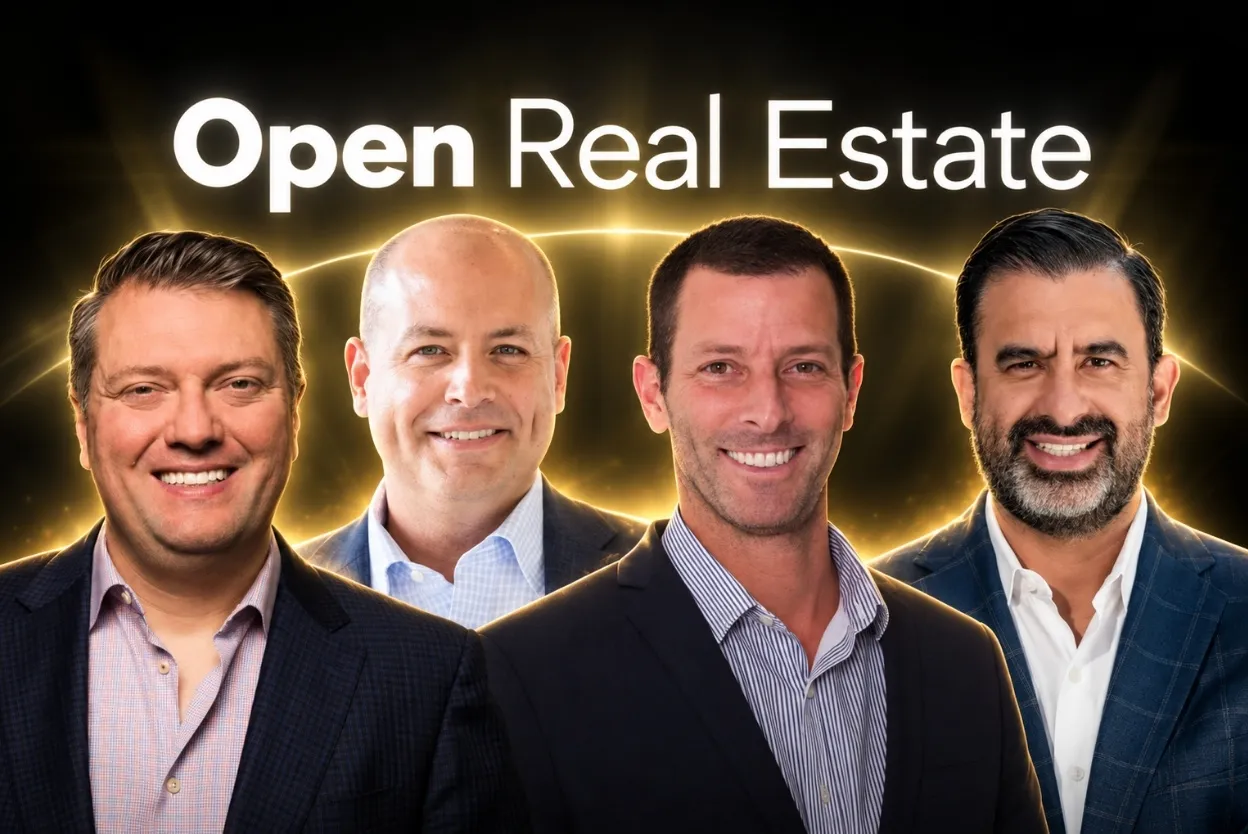
Open Real Estate is a new national listing-sharing initiative expected to launch in Q1 2027, backed by four of the biggest brokerages in the country: AGNT, Inc, Real REMAX Group, HomeServices of America and Keller Williams.
When the news broke on October 26, all four founding executives joined Byron Lazine live on BAM YouTube. CEOs Leo Pareja, Tamir Poleg, Chris Kelly and Chris Czarnecki explained why they’re joining forces, how the platform will work, and what it means for the future of real estate.
Hundreds of viewers tuned in as the announcement dropped, and the exclusive interview surpassed 10,000 views in under 24 hours.
It’s rare to get four executives who lead competing brokerages together for an interview. Getting all four live the moment their industry-changing initiative is announced is even more unusual.
From the role of MLSs and ownership of listing data to revenue sharing and the future of property searches, the executives answered the questions agents and brokerage leaders want to know.
Here’s what they revealed in the BAM exclusive interview.

What is Open Real Estate and Why Now?
Lazine opened the discussion with the question, “What is Open Real Estate, and why now?
Czarnecki began by addressing the “why” since it sets the stage for everything else:
“Open Real Estate is coming together today because we see a continued fragmentation in the real estate space and the industry, and we feel very strongly that the American consumer, both buyers and sellers, deserve the most transparent, complete, and open data set…so that they are absolutely informed and have the clearest view of what is available to them in the market as buyers, and they maximize their opportunities as sellers.
“The four of us have come together because we have a strong view that this pro-consumer stance is one that has to be taken today based on what we see is a continued fragmentation in the industry and listings not being widely available, data quality being subject, and agents not being able to compete on the value they deliver but ultimately their access to information.”
Lazine’s next question probed a bit deeper, asking what it means to have an open real estate market. Pareja explained how the new, unified system will work for users:
“From a technical standpoint…we’re going to simplify everything. So, in a future state, we will have a single input, slimmed down, very few fields, that will input into one or multiple databases together. And it’ll be really straightforward. If your seller wants to have it private, it’ll be private, but all the participants can see it. And once it’s public, within a business day, it will be available to all. And we will make sure that the information is available and syndicated to every party that needs to see it.”
He also reiterated why this is so important right now:
“By the way, this is a really powerful thing because we don’t want to end up like Europe or Latin America, where it takes a year to sell a house. You can’t pull comps. If we don’t protect the data and the completeness of the data set, we could be in a world where a 3% mortgage down payment doesn’t exist in this country. The 30-year mortgage is at risk. Most other parts of the world, you have a three-year ARM, and it’s 10% and 30% down. So, this is really for the American consumer to protect the middle class, and protect the most important asset Americans have in their net worth.”
Lazine then asked what this will mean for real estate agents:
“How does it work when I have a listing? What’s my function as a user?”
Pareja led with an important clarification:
“This does not replace the MLS. This is going to work alongside MLSs. So an agent whose brokerage is participating in open real estate can still input it at their local MLS level or use the input that we will provide to the industry. But this is all about just having the data available to everyone who’s participating and endeavoring, representing buyers and sellers.”
Lazine pointed out how in the early 2000s and 2010s, the brokerage community “really fell behind in tech,” and asked, “How confident are the four of you in the ability of this software to work to make this initiative successful?”
Poleg responded by differentiating the tech part with the industry buy-in:
“I think that the tech part is easy. What is more important is the buy-in from the industry, the participation from brokers, from agents, the support that we will get. And this is why it’s so important to have four large companies around the table leading that charge, just because we have significant market share. I think that we have a significant impact on the industry, and we can invite more and more participants and it’s open to everybody. …Everybody is welcome to join. It doesn’t matter if you have 10 agents or 100,000 agents, you’re an equal participant in this initiative.
“This is the important part that we’re trying to communicate today. It’s not about technology. Technology can be built. It’s the buy-in that matters.”
Asked whether all major brokerages have been invited already, Poleg added this, leading with a name currently at the center of multiple MLS lawsuits.
“So, we did invite Compass as a founding partner in this initiative, founding member. We are inviting all brokerages in the country to be participants in this initiative. They can go to openrealestate.com now and register or reach out to each and every one of us.…everybody’s invited and hopefully we can get as many buy-ins as possible.”
The 4 Deliverables and What They Mean for Participating Brokerages and Agents
Lazine brought up the four major deliverables in the open letter for Open Real Estate:
- Expand buyer opportunity
- Empower informed seller decisions
- Protect data integrity
- Promote fair competition
Focusing on the third deliverable, he asked, “Who’s going to own this data?”
Pareja responded with this:
“The data is going to be owned by the brokers themselves and members participating in Open Real Estate will allow the syndication of the data to make sure it ends up in all the correct places.”
Lazine then asked about the process agents and brokerages can expect once Open Real Estate is live.
“That’s a great question. And obviously, there’ll be a sequence. Behavior takes time to change. All four of our companies are going to develop a single input for our agents, but if a brokerage doesn’t have that capability, they could use the UI that we will provide. And also if they use the input at the MLS level, but they’re members, we will have that information syndicated back to this data set so it can go everywhere it needs to go.”
Kelly echoed Pareja’s point and added:
“The idea here is that we’re actually going to make things more simple. If you think about the current framework within the MLS as an input, it’s actually just a kind of a modern day version of what the MLS books were in the past. The MLS technology today is just really mirroring what that was, which is every local market had their own book and then that book went out to all the members. And we’ve just replaced that now with an MLS and a local level.
“So, the idea here is more and more of this is becoming national. The idea is to simplify the process so that all the data goes into one place. And so ultimately we believe for the MLS partners that we will be working with, for the portals that we’ll be working with, this is actually an improved process for everybody that would be involved.”
Lazine shared his perspective on what Open Real Estate would mean for the industry, and how it could shape public perception, as well as who might push back:
“This initiative, to me, is a form of saying, ‘Hey, we’re going to self-govern a little bit here for the better of the industry, the better of consumers, creating a very transparent and visible marketplace.’ Will there be any pushback on something like this? It seems like a no-brainer.”
Czarnecki acknowledged the potential for pushback but ultimately sees only advantages for brokerages that join. The four founders fully respect local MLS rules and are not planning to negate any or impose new ones:
“This is a push for transparency across the industry. I’d also point out that we are trying to make this, as Chris Kelly said, as easy as possible. And we’ll have very few rules ultimately governing what goes into the database, outside of the basic fields that we need to make it happen….And then we do see that local rule function still existing at the local level with the local MLSs. And that’s frankly what they’re exceptionally dialed into. Those are the communities they serve and they will know exactly what governance they need there. So this is a collection of data that we can then control and make it very clean and user-friendly and simple and distribute nationally. And then we can leave some of the other rulemaking that’s more bespoke to the communities and the local MLSs to them.”
How Do Consumers, Agents & Brokerages Benefit?
Lazine asked how they see the relationship between Open Real Estate and the major home search portals consumers rely on for home search (Zillow, Realtor.com, Homes.com, Redfin…).
Kelly sees the goal for that relationship as “very positive.”
“We have been very adamant that open real estate is not intended to be a consumer-facing portal. That is not the intent behind it, and it’s not the infrastructure that’s being put in place. And so we anticipate to have a very positive relationship with the portals where there are hundreds of thousands of consumers that begin their search process on those sites. And we look forward to having the conversation with them on how Open will be able to work together.”
Pareja confirmed portals found out about Open Real Estate with the rest of the industry when the announcement dropped on October 26. Poleg then segued to how the unified infrastructure will benefit portals as well as the consumers who rely on them:
“We also see some benefits for portals in that type of infrastructure that we’re building. Just think about a certain portal needing to access just one data feed instead of hundreds of different MLSs. I think that makes their lives easier. So there are some benefits and obviously we are going to engage in conversations with all of them and try to work in partnership.”
Finally, the conversation turned to the question of monetization and who would benefit from it.
Pareja explained it this way:
“Once the data is aggregated, there is monetization, and we will share it equally with all participating brokerages. So, you could be a 10-person brokerage and if you participate with a hundred listings, you will be compensated per listing in the same way that someone with a thousand or 10,000.
“So, not only do we want to democratize the data, we want to democratize the monetization so every brokerage independent of size would not exist. And even in our conversations of putting this together, the company I run and the company Tamir runs would have never existed if it wasn’t for fair and equal access to data.
“In other countries, behemoths have a monopoly, and you can’t enter as a small company. So we want to make sure that that was a core opportunity for everybody participating.”
Poleg added the shared concern for agents’ benefit as well as brokerages’:
“We also want to ensure that agents participate in the economics as well, not only brokerages. So that’s something that is on our mind as well.”
What Needs to Happen for This to Succeed?
Lazine then brought up the future of Open Real Estate, and asked:
“What looks like success in the future and what needs to happen to create that success?”
Czarnecki responded:
“I think there’s a few things that need to happen to create that success. One is we need to, the four of us and the supporting brokers that signed the letter today, need to continue to get out and tell this message in a dynamic way and make it very clear why this is a win for the US consumer, the home buyer and the home seller. I think that’s immensely important. and how it supports the broader housing ecosystem. That is job number one for us.
“Number two, it’s to carry that same message and to talk to other brokers and welcome everybody in and continue to build along the support. I think we believe there are many more in our space who will align with our core principles of supporting the housing system and consumer fairness and advocacy.
“And then there’s a tactical approach to it, too. We need to finalize our governance and long-term planning. We’ve already started on the tech front. We’ll continue to get that in place in a very short order. We’ll engage with the MLS community, and we’ll build the Open Real Estate staff and team over the next couple of months. So there’s a lot to do in a very short order.”
Kelly remarked on the irony of Open Real Estate’s success, in regards to consumers:
“What’s ironic is the more successful Open Real Estate is, the less the buyers and sellers, the ultimate consumers, will even have an idea that it’s out there… True success for them is that the system just works. Sellers have the opportunity to be in front of the most buyers and also to understand what their competition is, who they’re competing against. And then buyers have access to all of the available listings that are for sale in their particular marketplace. And so if Open does its job, buyers and sellers are unaware of what’s happening. They just know that the system is working for them.”
The Technology and Investment behind Open Real Estate
Lazine circled back to the tech behind Open Real Estate and whether it’s in-house or external to the founding brokerages.
Pareja took this one:
“We’re using third-party, best-in-class technology. We want to make sure this is durable and separate from all of us. And I will remind you, we compete fiercely with each other every single day for agents, for market share, for everything else. But we put all that aside just to create this initiative to make sure we protect the American consumer.”
Poleg added this about the investment he, Pareja, Czarnecki and Kelly are making to found Open Real Estate:
“I also would say that beyond just the idea, this will require massive investments, capital investments, and we’re ready to make those investments. And this is how important that topic is for all of us.”
What to Expect
Lazine asked whether there’s a cost for brokerages to join Open Real Estate and how long they should expect to wait until the infrastructure is fully up and running:
Pareja covered both points:
“There is no cost to sign up. We want to make it as easy as possible for brokerages of all sizes to participate. We have RFPs with very large technology companies, and we’re planning to have this operational in Q1 of 2027.”
Check out openrealestate.com to learn more and register.