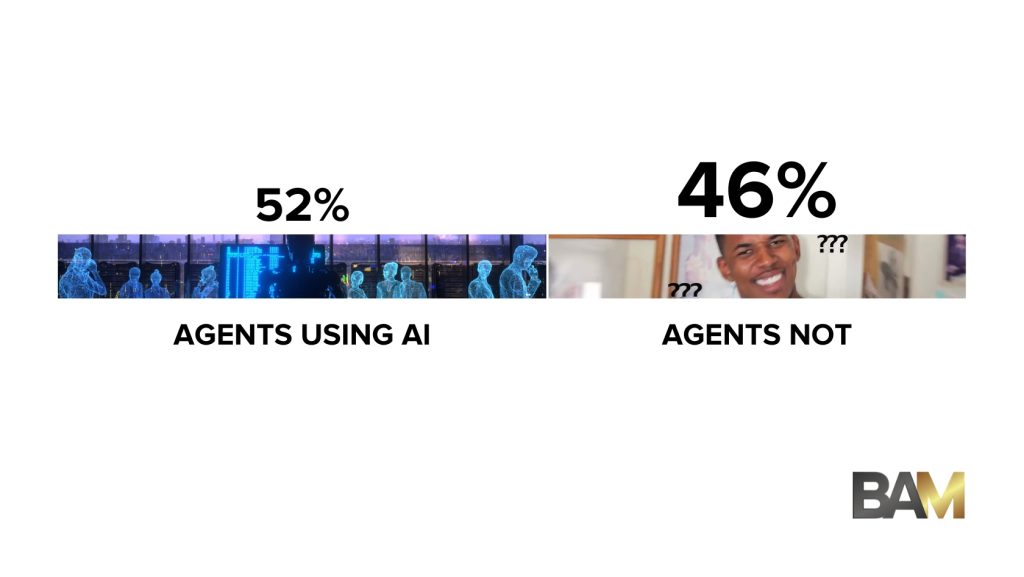
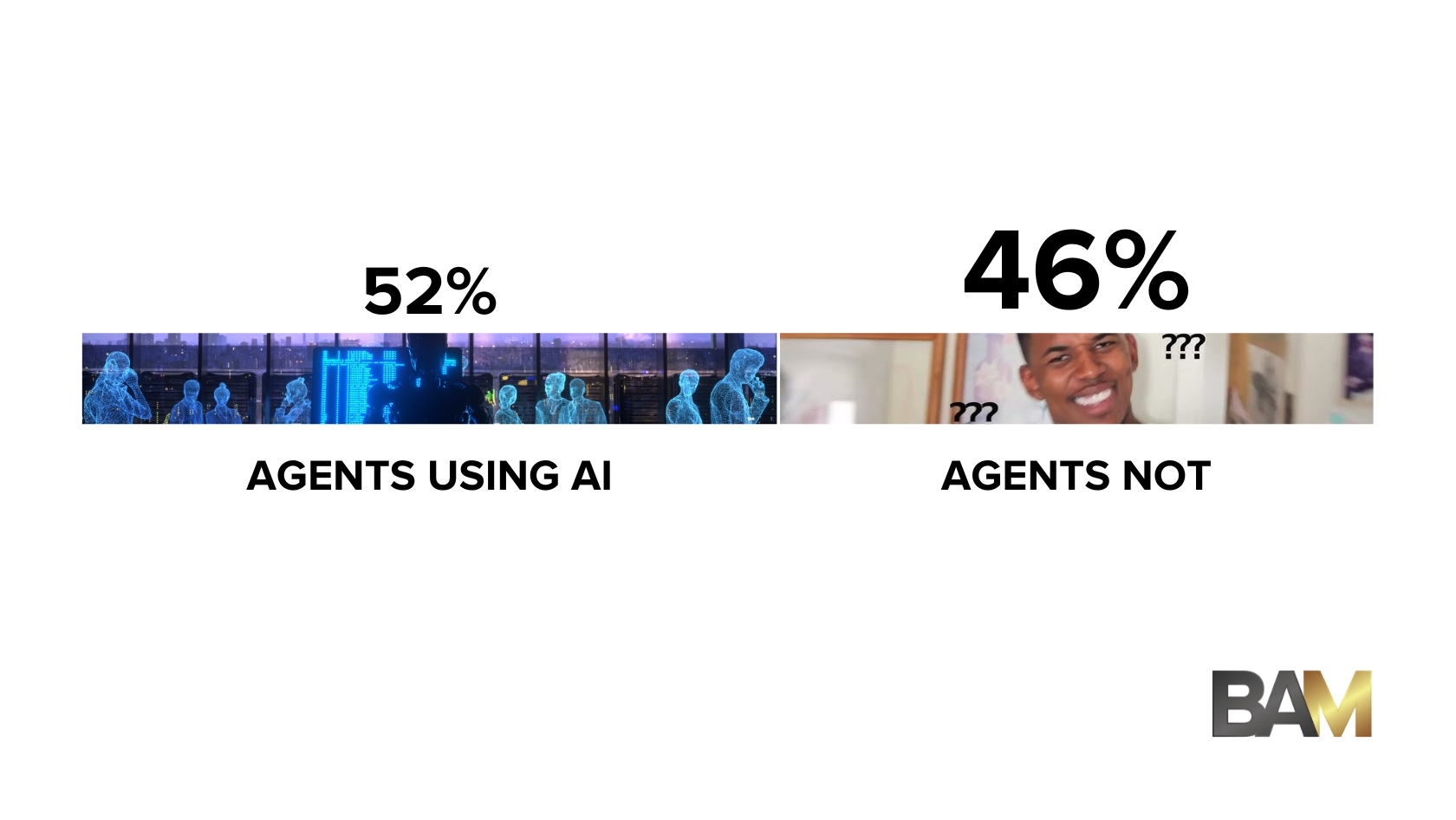

Kaplan Real Estate Education’s 2025 Survey of Trends revealed an eye-opening stat on the use of AI by real estate agents: nearly half of them (46%) say they’re “not using AI at this time.”
And about one in six (17%) say they “do not intend to use AI in the next one to three years.”
If you’ve been exploring AI tools like ChatGPT, ListingAI, CapCut, etc., you know these tools are developing by leaps and bounds. And some agents are even sourcing leads through ChatGPT.
Real estate portals and platforms are increasingly taking steps to integrate with AI tools to improve user experience and make it easier for consumers to find the right homes.
So, why are so many agents still working as if learning how to leverage AI isn’t worth their time?
Especially when 82% of consumers are using AI to get info on the housing market. These are the people hiring real estate agents, and likely assuming those agents are just as AI-savvy as they are.
How Agents Are Using AI Right Now
According to Kaplan’s data, the agents who are using AI are applying it to a range of marketing, communication, and administrative tasks.
Here’s how respondents say they’re currently using AI in their role:
- AI-powered social media content creation or scheduling (22%)
- AI for personalized email marketing (21%)
- Using AI to assist with administrative tasks (e.g., calendar management, transcriptions, document analysis/summarization) (17%)
- AI tools for comparative market analysis and pricing recommendations (11%)
- Using AI to identify market trends and insights (11%)
- AI-powered insights within CRM systems to understand client behavior (8%)
- AI chatbots for initial client inquiries (8%)
- Using AI to analyze property data and identify suitable matches (8%)
- AI-driven property recommendations systems for clients (5%)
- Virtual tours and property visualizations generated with AI assistance (5%)
- Predictive analytics for identifying potential leads (5%)
- AI-powered lead scoring and prioritization (4%)
- Other (4%)
The data shows most agents using AI are sticking with content and administrative support tools rather than diving into analytics or predictive features.
Adoption seems to be starting where the learning curve is lowest:
- creating marketing content
- organizing tasks, and
- streamlining communication
How Agents Expect to Use AI in the Next 1–3 Years
When asked how they anticipate using AI in the near future, agents’ responses revealed a broader and more strategic focus.
More than a third plan to use AI for their social media and email marketing content. But many expect to move beyond marketing and administrative work to include analytics, lead generation, and personalization.
- AI-powered social media content creation or scheduling (36%)
- Using AI to identify market trends and insights (35%)
- AI for personalized email marketing (34%)
- AI tools for comparative market analysis and pricing recommendations (33%)
- Using AI to assist with administrative tasks (e.g., calendar management, transcriptions, document analysis/summarization) (30%)
- Using AI to analyze property data and identify suitable matches (27%)
- Predictive analytics for identifying potential leads (23%)
- AI-powered insights within CRM systems to understand client behavior (22%)
- AI-driven property recommendations systems for clients (20%)
- Virtual tours and property visualizations generated with AI assistance (20%)
- AI chatbots for initial client inquiries (18%)
- I do not intend to use AI in the next 1 to 3 years (17%)
- AI-powered lead scoring and prioritization tools (16%)
- Other (4%)
The shift in responses suggests that while adoption is still slow, many agents see AI as a valuable long-term business tool.
The increase in categories like predictive analytics and trend identification points toward a growing recognition that AI can support smarter decisions, not just faster content creation.
Why Nearly Half Still Aren’t Using AI
While many agents are exploring new AI tools, nearly half have yet to take the first step. Several factors may explain the gap:
- Knowledge gap: Many agents don’t know where to start or which tools are most effective.
- Training gap: More than half (52%) of agents say traditional brokerages are not doing enough to prepare them for a technology-driven future.
- Skepticism and overwhelm: Some remain unsure of AI’s accuracy, while others feel overloaded by constant updates and new features.
Even with the growing accessibility of AI tools, the lack of structured training and support continues to slow adoption across the industry.
What’s Coming Next
If current trends hold, AI adoption will likely expand across key business functions. The most significant growth areas identified in the survey include CMA tools, predictive analytics, and AI-assisted email and video marketing
Real estate platforms are also accelerating their own AI integrations, giving consumers more data and personalization than ever before.
As these technologies become standard, agents who understand how to apply AI in their daily workflow will be better positioned to meet client expectations and compete in a data-driven market.
Those who begin exploring AI now can start small:
- Generate social captions in ChatGPT,
- Automate follow-ups with their CRM, or
- Use transcription tools to summarize calls and meetings.
Every small win builds efficiency and comfort with the technology.
The 2025 Kaplan survey reflects a clear divide between early adopters and those standing still. Agents who experiment with AI now will adapt more easily as new tools become standard. And since consumer expectations are already shifting, the timing couldn’t be more critical.
AI won’t replace the human touch that defines the best agents. It simply helps you spend more time on what matters most: client connection, strategy, and results.