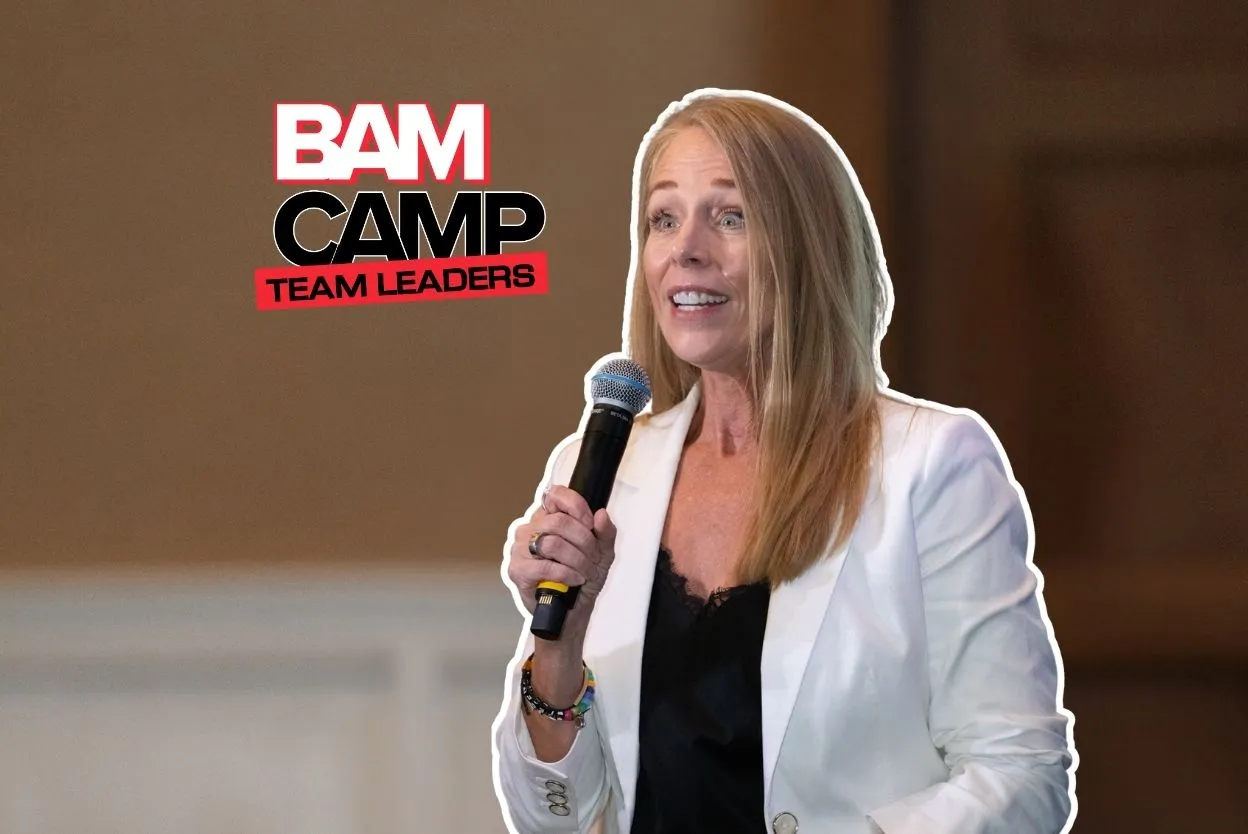

Amy Stockberger‘s father taught her a lot about real estate before he sent her out on her own.
Three lessons were missing from what he passed down, because nobody had taught them to him. Those missing lessons cost him money when he sold his brokerage.
She opened her talk at BAM Camp Team Leaders with what she wishes her dad had known.
“Nobody taught him how important it was to build a business around the lifetime value of the relationship, not just the value of the transaction. Nobody taught him how important it is to care for the client far after the closing table to make it irreplaceable so the repeat and referral can be reliable. And nobody told him how vital it is to have additional revenue streams outside of commissions to make the business market-proof.”
Amy runs Amy Stockberger Real Estate in Sioux Falls, SD. Her team of 20-some agents handles about 10% of its market. It has ranked #1 there since building its current model and ranks #37 in the nation.
Amy figures team leaders know their own numbers. Her question is whether their agents know them.
She wants every agent on a team to understand three numbers, and each one depends on how long a client relationship lasts.
#1: Lifetime Value
The first number is lifetime value. It’s the total income one client relationship brings in over the years. Amy walked team leaders through an example using a $10,000 commission.
“You know what the LTV is, but do they know when a client transacts one time, it’s 10—say they’re a 10,000 dollar commission, we’re pretending. They can transact again, that’s another 10. Say they get one referral. So, that client is not worth $10,000, the transaction costs. That client’s lifetime value is $30,000. Our average agent in little South Dakota, their lifetime value, their relationship value is $98,000. So, we train our agents not to see the transaction, but rather to nurture that relationship using the tools we’re giving them to serve.”
For Amy’s team, building that relationship value goes well beyond the closing table. She described what happens to every buyer and seller once the deal closes.
“We activate them into the forever client. We don’t have past clients….We only have forever clients. And from there, they go into the repeat, the referral, the review loop and then they zip back into transaction with us.”
The team gives agents tools to keep those forever clients close after the sale. Here are two of the biggest:
- A VIP club where clients can borrow equipment branded with the team’s name, like moving trucks, party supplies, tools and carpet cleaners
- Software that alerts the agent in real time when a client checks out a piece of equipment, so the agent can reach out while the moment is fresh
The club serves the full range of clients, from first-time buyers to luxury clients.
#2: Customer Referral Value
The second number is customer referral value. It’s the business a client sends your way through friends, family and anyone else they know.
Amy says her team’s referral business comes from serving clients before asking for anything.
“What we found is when we serve at this higher level, when we serve before we sell, the law of reciprocity kicks in hard. 90-some percent of our business can be traced back to repeat and referral. And here’s a sexier stat….Humans trust referrals from friends and family 92% more than any other marketing or advertising campaign. Hear that again. 92% more than any other dollar you’re spending in your business.”
Amy’s team gets referrals from more places than its own client list. The team runs a program that top local companies, like HVAC contractors and electricians, pay to join. Access to their employees is part of the deal.
Here’s what that program brings in:
- $880,000 in GCI (gross commission income) from vendors and vendor employees who refer the team, according to Amy’s 2026 numbers
- A steady list of referrals from companies that sat through the team’s sales meeting and chose not to join
#3: Cost to Acquire
The third number is cost to acquire. It’s what a team spends to bring in each new client.
Amy knew it cost more to win a new client than to keep one she already had. For about a decade, her team ran marketing campaigns to remind people who knew and trusted them to come back. The biggest was a billboard campaign that cost $30,000 a year.
The team’s top 20 pieces of VIP club equipment cost less than $4,000 to buy at current prices. Amy explained what happened when the team dropped the billboard and put that money into the club.
“We replaced a $30,000 a year billboard ad campaign with this small little VIP club and that had a 38,000% ROI. And it allowed us to shut off a ton of low to no [return] marketing expense. It allowed us to turn our marketing department into a lifetime home support marketing engine.”
Amy put the blended average cost to acquire a client at $2,500 for the industry. She said her team has its own cost down below $125. She tied that lower cost back to the client’s lifetime value.
“The goal is to make that relationship worth more and it helps drive cost to acquire down. And you can do that with the serve, serve, serve, sell business model.”
How Team Leaders Can Coach Agents on the Numbers
Amy gave team leaders a set of steps for building a client system like hers. Knowing the numbers is one of those steps.
“Make sure you nail those numbers. I know you guys have those numbers, but do your agents? What numbers do they need to know so that they are looking at it from the perspective of keeping clients for life too—the lifetime value, the customer referral value and the cost to acquire?”
Agents on a lot of teams ask their leaders what they should say to clients after the sale. Amy’s team answers that by giving agents something real to offer at each stage of the client journey.
She told team leaders to map out that journey for their own agents.
“You need to map your client journey. You need to put as many human moments as you can at every single stage. Our forever clients get touched over 150 times a year, and that doesn’t include the vendors who are talking to them. All in a service first way, no commission breath.”
Amy asked team leaders to think about what it costs them when agents lose touch with the people they’ve helped.
“Is it hard watching your agent’s past clients go list with somebody else? Is it hard listening to your agents come tell you, ‘Oh, one of my best clients’ sister just moved to town and they ain’t used me.’ No shit. They haven’t even talked about you for the last two years…
“You need to pick that hard and you need to control what you can control… What we can control is that we are hell bent on being irreplaceable and we do that by serving first.”
Putting the Three Numbers to Work
Amy closed her talk by going back to her dad’s story and the lessons he couldn’t pass on to her.
“Nobody ever taught him. You don’t have that excuse anymore. Somebody just taught you.“
She ended with a challenge for the room
“Go solve the most amount of problems for the most amount of people in your market and do it on the foundation of serve, serve, serve, sell. You’ll build an even bigger, hyperlocal, referable, scalable, and ultimately sellable business for your entire organization.”