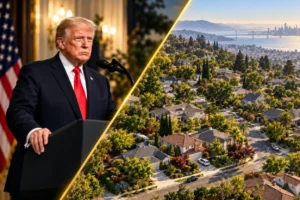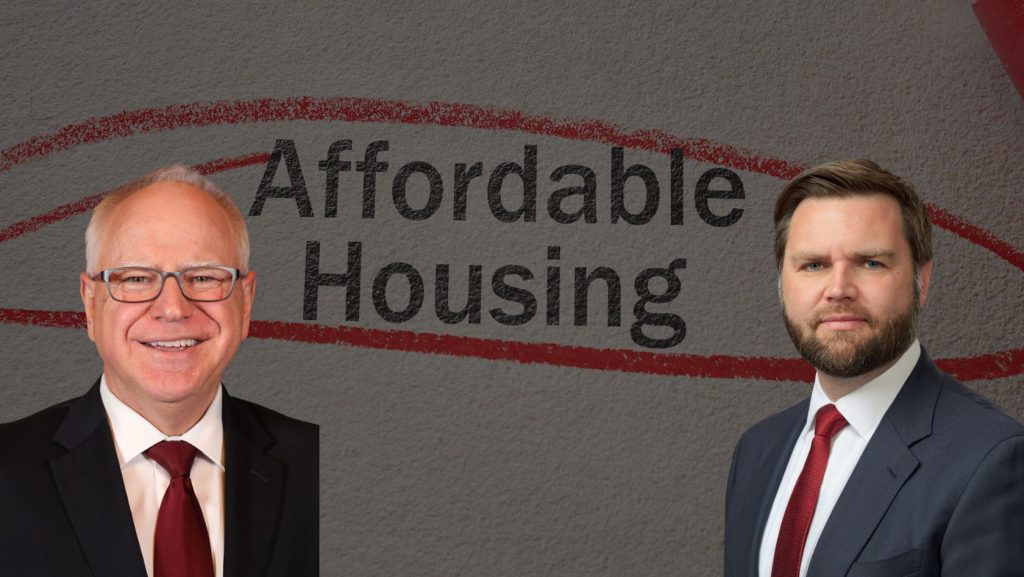
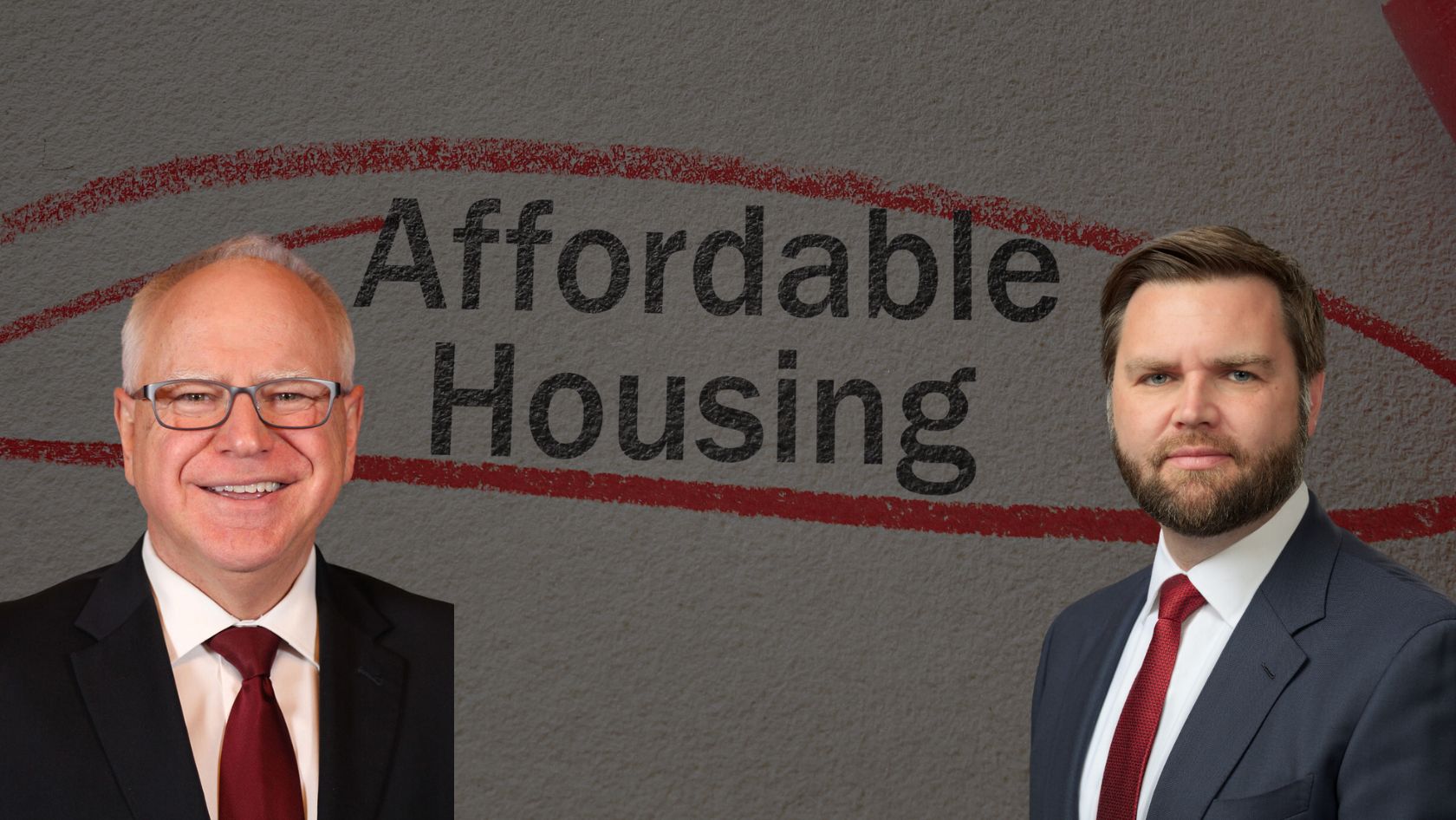

Last night, Minnesota Governor Tim Walz and Ohio Senator JD Vance took the stage for the vice presidential debate.
Similar to the September presidential debate, both candidates discussed a wide range of topics, including the economy, immigration, reproductive rights, gun violence, and healthcare, among others. However, unlike the Trump-Harris debate, in which housing was discussed for just 42 seconds, both Walz and Vance brought up the topic of housing numerous times throughout the 2-hour debate.
The candidates didn’t just mention housing in passing, either. They dove into the growing crisis of affordability and the housing shortage in a lengthy segment moderated by CBS’s Norah O’Donnell and Margaret Brennan.
Below, we break down their full conversation as it relates to housing.
Questions Specific to Housing During the Vice Presidential Debate
About an hour after the debate began, the discussion shifted to housing when Brennan asked each candidate questions specific to housing affordability and shortages.
Both candidates acknowledged the severity of the housing crisis but disagreed on its root causes and how to solve them. Governor Walz backed federal down payment assistance programs and called for reducing local barriers to construction, emphasizing the need to view housing as a public good rather than a commodity. Senator Vance pointed to immigration and regulatory constraints as major drivers of high housing costs, advocating for building on unused federal land and lowering energy costs.
Below, we share the full transcript of their exchanges on housing and related policies.
Question for Governor Walz about Housing (Brennan) (01:07:29):
“Let’s turn now to the top contributor to inflation: the high cost of housing and rent. There’s a shortage of more than 4 million homes in the United States and that contributes to the high housing prices. Governor Walz, the Harris campaign promises a $25,000 down payment assistance for first-time home buyers and a $10,000 tax credit. They also promise to build 3 million new homes. Where are you building these homes, and won’t handing out that kind of money just drive up prices higher?”
Walz’s response (01:08:03):
“No, it’s not handing out. We have—first, let me say, this issue of housing, and I think those of you listening on this—the problem we’ve had is that we’ve got a lot of folks that see housing as another commodity. It can be bought up, it can be shifted, it can be moved around. Those are not folks living in those houses.
“Those of you listening tonight, that house is a big deal. I bought and owned one house in my life. My mom still lives in the house where I was, and when I think of a house, I’m thinking of Christmas services after midnight mass, where you go with your family.
“We need to make it more affordable and one of the things, as I said, this program that the vice president is pushing forward and bringing a new way of approaching this is something we’re doing in Minnesota from that lead. We in the state invested in making sure our housing was the biggest investment that we’d ever made in housing. It starts to make it easier. We cut some of the red tape. Local folks—look, we can’t do it at the federal level—but local folks make it easier to build those homes. And then that down payment assistance. I can tell all of you out there, one of the—certainly for me, using the GI Bill was one thing—but a Veteran’s home loan, the big thing about a Veteran’s home loan is you don’t have to pay the down payment. Those are things that make it there. Now look, you’re going to pay it back, and you’re going to pay your mortgage. Those are things that we know in the long run, the appreciated value, that generational wealth that’s created from it.
“And I will give Minneapolis an example. Minneapolis is the one city where we’ve seen the lowest inflation rates. We’ve seen a 12% increase in stock because we’ve put some of these things in, and we’re implementing a state program to make sure we give some of that down payment assistance. We get it back from people because here’s what we know: people with stable housing end up with stable jobs. People with stable housing have their kids able to get to school. All of those things in the long run end up saving our money. And that’s the thing that I think we should be able to find some common ground in. But we can’t blame immigrants for the only reason. That’s not the case that’s happening in many cities.
“The fact of the matter is that we don’t have enough naturally affordable housing, but we can make sure that the government’s there to help kickstart it, create that base.”
Question to Vance about Housing (Brennan) (01:10:10):
“Senator Vance, as far as your campaign’s position, the promise is to seize federal lands to build homes, remove regulation, provide tax breaks, and cut back on immigration, which you say pushes up prices. Where are you going to build all the new homes you’re promising, and what part of any of this plan will provide immediate relief?”
Vance’s Response (01:10:33):
“Well, first of all, Tim just said something that I agree with. We don’t want to blame immigrants for higher housing prices, but we do want to blame Kamala Harris for letting in millions of illegal aliens into this country, which does drive up costs, Tim.
“Twenty-five million illegal aliens competing with Americans for scarce homes is one of the most significant drivers of home prices in the country. It’s why we have massive increases in home prices that have happened right alongside massive increases in illegal alien populations under Kamala Harris’s leadership.
“Now, Tim just mentioned a bunch of ideas. Now some of those ideas I actually think are halfway decent and some of them I disagree with. But the most important thing here is Kamala Harris is not running as a newcomer to politics. She’s the sitting vice president. If she wants to enact all of these policies to make housing more affordable, I invite her to use the office that the American people already gave her, not sit around and campaign and do nothing while Americans find the American dream of homeownership completely unaffordable.
“Now, you asked, Margaret, what would immediately change the equation for American citizens? If you lower energy prices, as Donald Trump says, drill, baby, drill. One of the biggest drivers of housing costs, aside from illegal immigration, is, think about it—if a truck driver’s paying 40% more for diesel, then the lumber he’s delivering to the job site to build the house is also going to become a lot more expensive. If we open up American energy, you will get immediate pricing relief for American citizens. Not by the way, just in housing, but in a whole host of other economic goods too.”
Follow-up question to Vance (01:12:10):
“Senator Vance, you still have 23 seconds there. Do you want to answer…where are you going to seize the federal lands? Can you clarify?”
Vance’s Response (01:12:21):
“Well, what Donald Trump has said is we have a lot of federal lands that aren’t being used for anything. They’re not being used for National Park, they’re not being used, and they could be places where we build a lot of housing. And I do think that we should be opening up building in this country. We have a lot of land that could be used. We have a lot of Americans that need homes. We should be kicking out illegal immigrants who are competing for those homes and we should be building more homes for the American citizens who deserve to be here.”
Follow-up question to Walz (01:12:46):
“Senator, your time is up. Governor, I do want to let you respond to the allegation that the vice president is letting in migrants.”
Walz response (01:12:54):
“Well, of course, that’s not true. And again, you have the facts. I guess we agreed not to fact-check. I’ll check it; look, crossings are down compared to when Donald Trump left office. But it’s again, blaming and not trying to find the solution. I was going to ask, though, on this question, are we going to drill and build houses in the same federal land? And I think when people hear federal lands, these are really important pieces of land. Now, Minnesota doesn’t have a lot of federal lands. I know in the western part of the countries we do. There’s not a lot of federal lands in and around Minneapolis, for example. So the issue is, I don’t understand the federal lands issue, unless we see this—and I worry about this as someone who cares deeply about our national parks and our federal lands. Look, Minnesota, we protect these things. We’ve got about 20% of the world’s fresh water. These lands protect, they’re there for a reason. They belong to all of us.
“But again, this is when you view housing and you view these things as commodities. ‘There’s a chance to make money here. Let’s take this federal land, and let’s sell it to people for that.’ I think there’s better ways to do this. We’ve seen it in Minnesota. We’re able to refurbish some of these houses. We’re able to make some investments. That gets people in. And I’m still on the fact on this. Economists—Senator Vance, you said you don’t like the economists. Which economists are saying that it is immigrants that’s adding to the cost?”
Follow-up question to Vance (01:14:03):
“Senator, on that point I’d like for you to clarify. There are many contributing factors to high housing costs. What evidence do you have that migrants are part of this problem?”
Response from Vance (01:14:17):
“Well, there’s a Federal Reserve study that we’re happy to share after the debate—we’ll put it up on social media, actually—that really drills down on the connection between increased levels of migration, especially illegal immigration and higher housing prices.
“Now, of course, Margaret, that’s not the entire driver of higher housing prices. It’s also the regulatory regime of Kamala Harris. Look, we are a country of builders. We’re a country of doers. We’re a country of explorers. But we increasingly have a federal administration that makes it harder to develop our resources, makes it harder to build things, and wants to throw people in jail for not doing everything exactly as Kamala Harris says they have to do. And what that means is that you have a lot of people who would love to build homes who aren’t able to build homes.
“I actually agree with Tim Walz. We should get out of this idea of housing as a commodity, but the thing that has most turned housing into a commodity is giving it away to millions upon millions of people who have no legal right to be here.”
For more, watch the debate in full here.