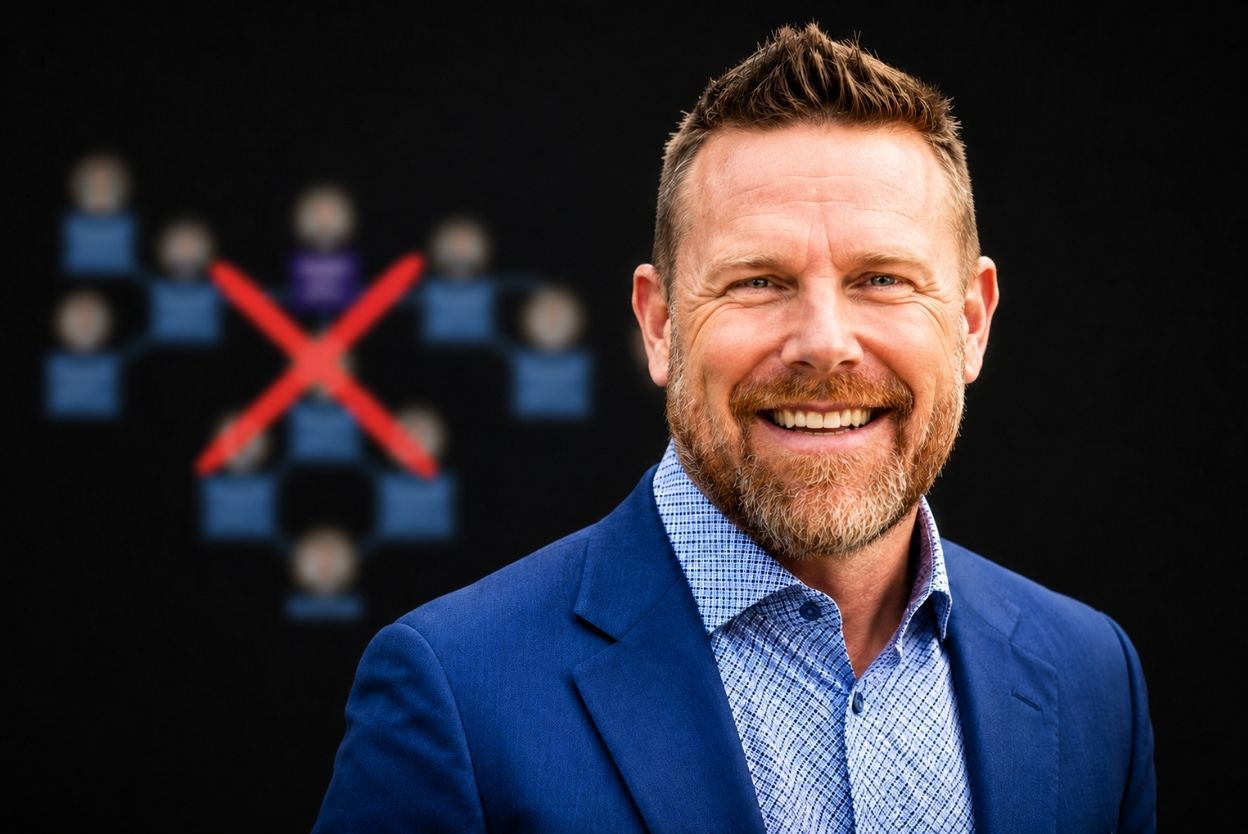

Most real estate team leaders build their org chart backward. They look at the people currently working for them, assign each person a position and call that the structure. When the team grows or a new leadership gap appears, they move those same people into different roles.
Dave Richards, who coaches some of the biggest teams in real estate, sees this repeatedly. In a recent Stay Paid episode, Richards told Luke Acree:
“A big problem that I’ll see is when I first work with a team, I’ll ask for their org chart. And candidly, their org chart is just built off of who they have on the team.”
The better approach is to define what the business needs next, and only then decide who should fill each role.
Your Current Team Is Not an Organizational Strategy
Building an org chart around existing employees can feel natural, especially when some of those people have been with the team for years.
They understand the business and the leader trusts them. That’s why, when the team needs a leadership position filled, promoting someone familiar can feel like the logical next step. But familiarity and loyalty don’t necessarily make someone right for a specific role.
Richards said team leaders often “just kind of move people around because that’s just who they have … not what they need and not where they’re going.”
That creates two problems:
- The position gets shaped around the available person instead of the outcome the business needs.
- The employee may be placed in a job that does not fit their strengths simply because they were next in line.
A longtime employee may be enormously valuable to the company and still be wrong for the role the company needs next.
Build the Seats Before Adding the Names
Before assigning anyone a title, team leaders should define where the business is going over the next 12 to 24 months.
That includes deciding:
- How many agents the team expects to support
- What production and profit it is trying to reach
- Whether the founder will remain in production
- Which responsibilities need to operate without the founder
- Where the business is already experiencing a bottleneck
From there, leaders can identify the roles required to operate that version of the company.
Each role should have a clearly defined outcome, responsibilities, decision-making authority and measurable indicators of success. Only after the seats are defined should names be added to the chart.
This changes the question from “Where can we put this person?” to “Who has the skills to produce the outcome this role requires?”
Evaluate the Founder, Too
The team leader’s position should not be exempt from this exercise.
Earlier in the conversation, Richards explained that leaders often envision the business they want to create without considering who they must become to lead it.
If the leader wants to build a company that can operate without them, they cannot remain the person who solves every transaction problem, approves every decision and provides all the value. Instead, they must determine what they should continue owning, what another leader needs to own and where their own strengths are limiting the business.
Acree connected that self-awareness to the speed at which a leader can make decisions:
“The guys who win, the girls who win, they just move at a lightning speed. And the only way to do that is to have the freedom to be comfortable with, ‘I know who I am. I’m willing to face the man in the mirror,’ as they say.”
Decide Whether to Develop or Recruit
Once leaders compare the structure they need with the people they have, some gaps will become obvious.
That does not automatically mean replacing longtime employees, but it does require making an honest decision about whether someone can grow into a position, or whether the company needs to recruit someone else.
Richards recommends asking: “Is this something that I can develop, or is this just something that I’m just not going to do, and I need to surround myself?”
Internal development makes sense when the employee wants the role, the missing skills can realistically be learned and the team can provide clear coaching and milestones.
An external hire may be necessary when the gap is already restricting growth, the role requires experience nobody on the team possesses or the internal candidate is simply better suited for different work.
The goal is not to punish the people who helped build the company. It is to give them clarity instead of promoting them into poorly defined positions and hoping they work out.
The Team Leader Play
Build a second version of your org chart this week.
Start with your 12-to-24-month business goals. Create the roles required to reach them, but leave every employee’s name off the page.
For each role, define:
- The primary outcome it owns
- Its most important responsibilities
- The strengths required
- Three measures of success
- The authority that person will have
Then compare that future structure with your current team.
Which people are ready now? Who could become ready with development? Which employees would perform better in a different seat? What capability is completely missing?
Most importantly, identify the unfilled or mismatched role most likely to become the team’s next ceiling.
Richards will be taking conversations like this deeper at BAM Camp: Team Leaders, September 22–23 in Scottsdale. The event brings together leaders building some of the country’s top real estate teams to share the structures, systems and decisions behind their growth.
BAM Camp is almost sold out. Claim one of the remaining spots here.