
The weekly average 30-year fixed hit 6.95% last week, an 18-month high, right after the Fed’s first rate hike in three years.
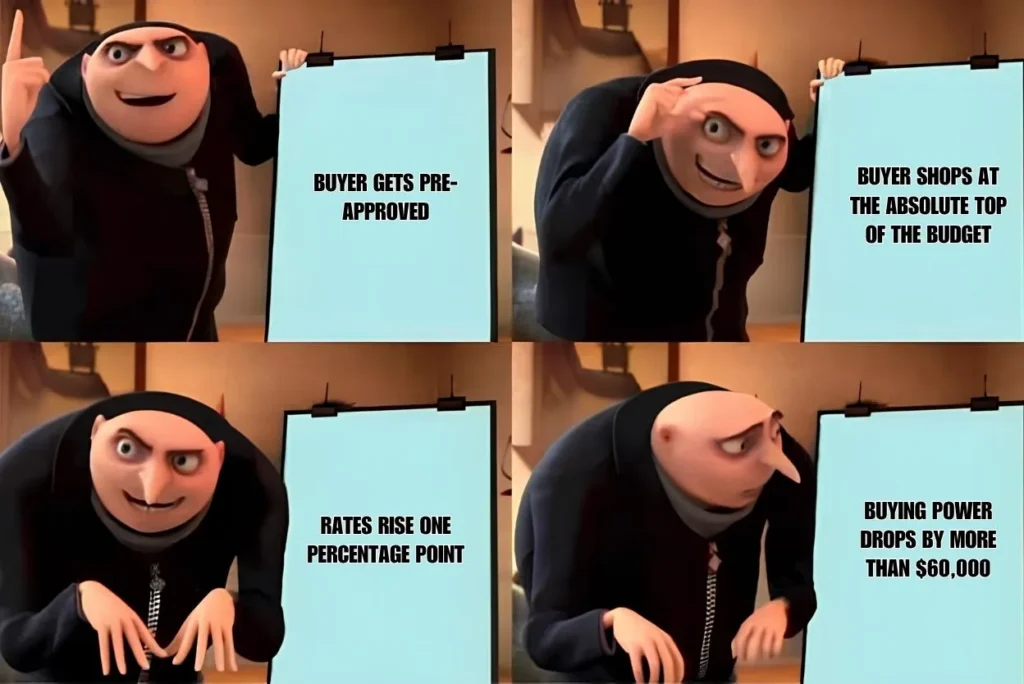
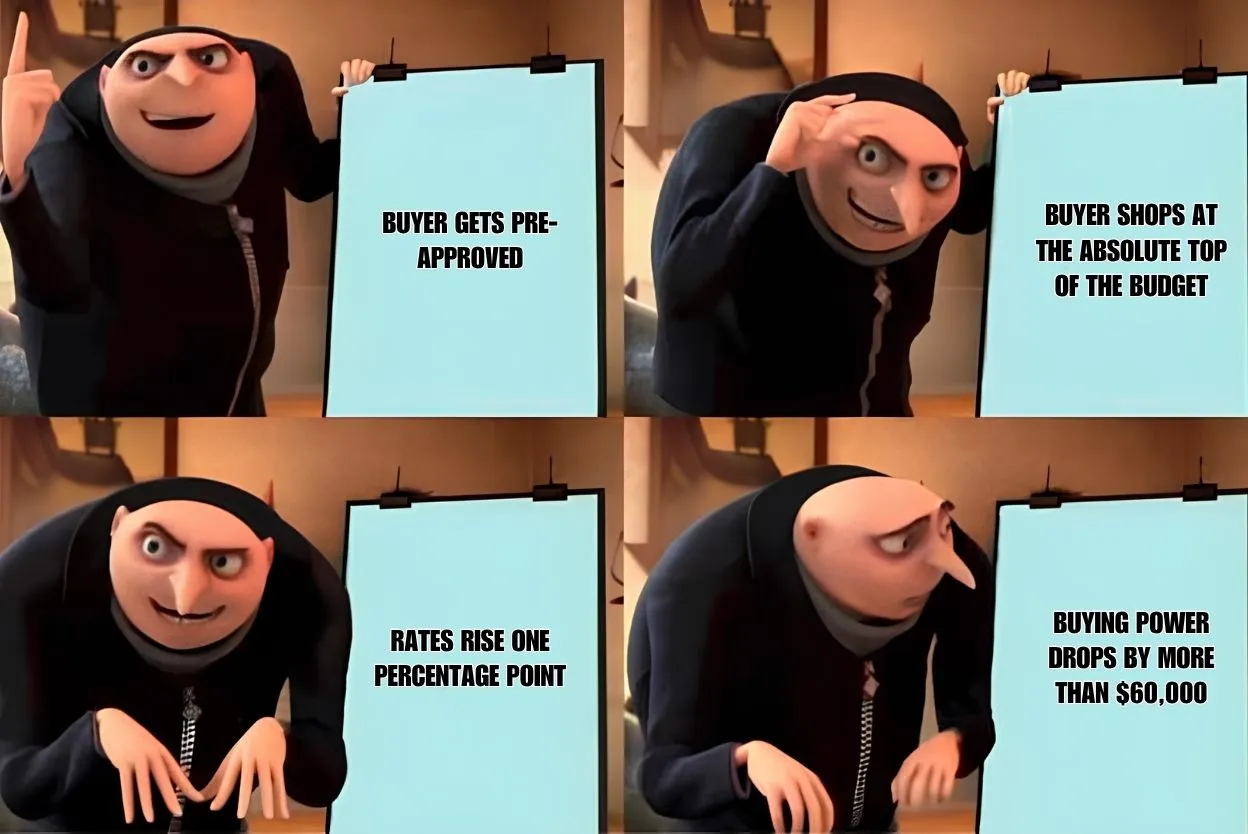
When a buyer 12 months from closing asks what that means for them, the honest answer is it could be a $60,000 swing in what they can afford. Much depends, still, on what happens between the U.S. government and Iran. And the uncertainty is making buyers hesitant.
Which is largely why existing home sales slowed in August. Today’s buyers are understandably unsure if they can manage a payment if rates keep climbing.
To clarify the situation Realtor.com pulled 20+ years of mortgage rate data into a framework you can use with any buyer, giving them a specific cushion to plan around whether they’re 12, 6, or 3 months from closing.
Let’s get into it.
Why Your Buyers Need Rate-Proofing Right Now
The weekly average for the 30-year fixed mortgage rate surged to 6.95% on September 17 (an 18-month high), driven by climbing 10-year Treasury yields.
The surge came a day after the Fed raised the federal funds rate, its first hike in three years. The daily average is even higher, up to 7.26% as of Wednesday, September 22.
Rates have been climbing for months, now, and existing home sales have slowed as more buyers grow uncertain about affording the monthly payment.
By now, you already know timing the market is not a viable strategy.
Ralph DiBugnara of Home Qualified says trying to time rates is next to impossible. Which is why he (and others) suggests rate-proofing instead:
“Rate-proofing for potential buyers right now is super important because they can’t build assumptions for their finances on the chance that interest rates may go down. They need to be comfortable with the monthly payment, whether the rates go down or up, and build their budgets around that. This is not a market where you can time for the best rate and the best price that’s the best fit for you.”
Realtor.com shared three different rate-proofing strategies agents can present to buyers, each with its own “cushion” built in.
The 12-Month Client: Build In 100 Basis Points
For a buyer 12 months from closing, the data points to a wide cushion. Realtor.com compared monthly Freddie Mac 30-year fixed rates going back to 2000 against where rates stood 12 months earlier.
Rates stayed within 25 basis points up or down 29.1% of the time, the single most common outcome in the data.
The middle 80% of outcomes ranged from -98 to +94 basis points. Round that up and you get a rule of thumb: build in 100 basis points of movement in either direction for a buyer a year out.
Here’s what that range means for a buyer working with a $2,000 monthly principal and interest budget:
- At a 6% rate, they can take on a loan balance of $333,583
- At an 8% rate, that drops to $272,567
- The difference is more than $60,000 in buying power
As Joel Berner, senior economist for Realtor.com, explained, $60,000+ is the cost cushion buyers are looking at when they plan 12 months in advance:
“The potential variability in rates one year out can create a range of over $60,000 in homebuying power for this hypothetical buyer.”
So, for a buyer with that $2K monthly budget for mortgage payments, the safest play is to shop for homes a bit more than $60K below the cost of the homes that fit their budget now.
The 6-Month Client: Build In 75 Basis Points
Cut the timeline in half and the range narrows. The middle 80% of six-month rate changes ranged from -63 to +63 basis points, so Realtor.com rounds that to a 75 basis point cushion.
Rates held within 25 basis points 37.2% of the time on this shorter window.
For the same $2,000 monthly budget:
- At 6.25%, a buyer qualifies for a loan balance of $324,824
- At 7.75%, that falls to $279,169
- The difference comes to more than $45,000
DiBugnara ties the size of that buffer to how far out a buyer is from closing:
“The further out buyers feel they are from actually closing on a home, whether it be 60, 90, 120, or 180 days, the bigger the payment buffer they are using as a variable should be. I would always want a buyer to be very conservative on the low side and use the high side of interest rate and monthly payments to make decisions on homes they want to purchase.”
Tania Jhayem of Keller Williams The Marketplace uses that same cushion to set expectations with clients from the start:
“If someone is six months away and planning around a 75-basis-point swing, we can establish their comfortable monthly payment first and then determine the price range that still works under that higher rate scenario. The goal isn’t necessarily to qualify for the maximum amount. It’s to make sure the purchase still feels financially comfortable if the market moves against you.”
The 3-Month Client: Build In 50 Basis Points
Close to closing, the range tightens again. The middle 80% of three-month rate changes ran from -40 to +45 basis points, which rounds to a 50 basis point cushion.
Rates moved less than 25 basis points in either direction 49.7% of the time on this window, close to a coin flip in favor of stability.
For that same $2,000 monthly budget:
- At 6.5%, a buyer qualifies for a loan balance of $316,422
- At 7.5%, that drops to $286,035
- The difference comes to about $30,000
Put those numbers against the median-priced home, $424,500 as of August, with a 10% down payment. At a 7% rate, the monthly principal and interest payment comes to $2,542.
Walk a client through both directions:
- At 6.5%, the payment drops to $2,415, $127 less per month
- At 7.5%, the payment climbs to $2,671, $129 more per month
Berner frames that $30,000 swing as proof even buyers poised to move this year need room to absorb further rate increases:
“This roughly $30,000 difference is still sizable, a sign of how much buyers need to be flexible.”
A Tighter Range for Clients Willing to Take on More Risk
Not every buyer wants the wide cushion above. Realtor.com also built a tighter, riskier range using the 25th and 75th percentile of historical rate changes instead of the 10th and 90th.
This tighter band covers half of historical outcomes instead of 80%, which means more risk if rates move against a buyer.
The 50% confidence range comes out to:
- 12 months: 40 basis points
- 6 months: 30 basis points
- 3 months: 20 basis points
Whichever range a client picks, give them a short list of things to do before they write an offer:
- Run their payment at more than one rate scenario before they make an offer
- Explain the fallback options if rates rise: rate buydowns, seller concessions, a bigger down payment, or a lower purchase price
- Encourage them to pay down revolving debt so their debt-to-income ratio has more room
Jhayem recommends buyers go into an offer already knowing their numbers:
“Buyers should know their payment at several different rate scenarios before they write an offer. They should also understand what options may be available if rates move higher, including permanent rate buydowns, seller concessions where appropriate, adjusting the down payment, or simply changing the purchase price.“
DiBugnara frames this as controlling what buyers can control, cutting other monthly debt and building savings before they start shopping.
Bring This Into Your Next Buyer Conversation
Every buyer you work with can plug their own numbers into a mortgage calculator and test their budget against these ranges before they start touring homes.
Treat rate-proofing as part of an ongoing conversation, not a one-time check at the start of a search. The cushion a buyer needs shrinks as closing gets closer, so what you tell them in month one won’t hold by month three.
A buyer who has already planned for rates moving in either direction is ready to act the moment the right home comes on the market. That readiness is what you’re offering when you bring this framework to a listing presentation or a first buyer meeting.