
A handful of mobile screenshots sparked a big conversation this week.
Real estate strategist Mike DelPrete shared three of them, positioned right after the title, “Google Enters the Portal Wars.” The market reacted, sending Zillow shares down more than 9% as stock holders worried this could signal a threat to the portal’s dominance.
The reason? Google was displaying full for-sale listings right inside search results.
DelPrete didn’t post the screenshots to stoke panic. His take was more about what Google’s experiment could mean long-term for real estate portals, and for the consumer’s home search experience in 2026.
It’s a significant move on Google’s part. And it’s worth being aware of. Hence the post.
And it’s got us wondering, “How is Zillow taking this?” As of yet, the availability of this new Google feature is limited to mobile use. But it’s still a clear move into real estate portal territory.
And Wall Street is paying attention.
Mike DelPrete’s Read: Why This Test Matters
Before getting into what Google built or where it’s live, DelPrete focused on the significance of the move itself.
“Google putting for sale listings directly into search results—even if it’s a test—is a big deal.”
Here’s why: Google isn’t just indexing listings or sending traffic elsewhere. It’s experimenting with hosting the experience.
With Zillow positioning itself as a homebuying “super app,” that’s a key distinction.
Because search has always been top of the funnel. Owning the experience inside search changes who controls discovery. And it could disrupt one of the key revenue drivers for Zillow and other portals, not to mention lead gen for real estate professionals.
What Google Is Actually Testing
Based on what’s visible so far, Google’s test includes several core features that have long defined portal value, which can be seen in the screenshots DelPrete shared.
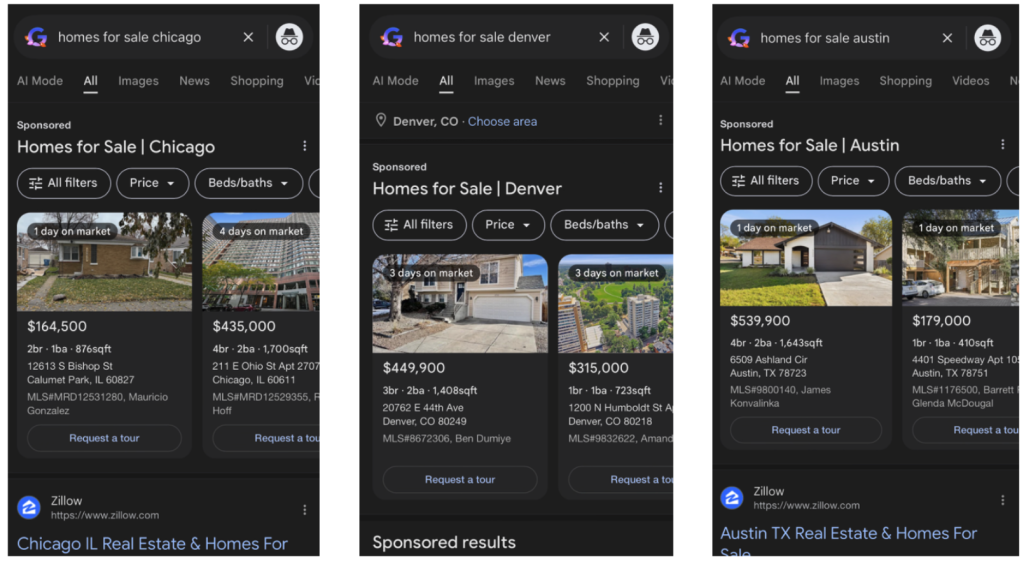
Source: Mike DelPrete
Before diving into implications, it helps to be clear on what this new feature, with its current limited availablity, actually does:
- Full property detail pages displayed directly in Google search results.
- Built-in options to request a tour.
- Direct contact options to reach an agent (suggested by Google)
- A mobile-only experience that appears limited to select markets.
- Listings powered through a partnership with ComeHome by HouseCanary.
- Clear labeling that listings are “not supplied or sponsored by listing agents or brokers.”
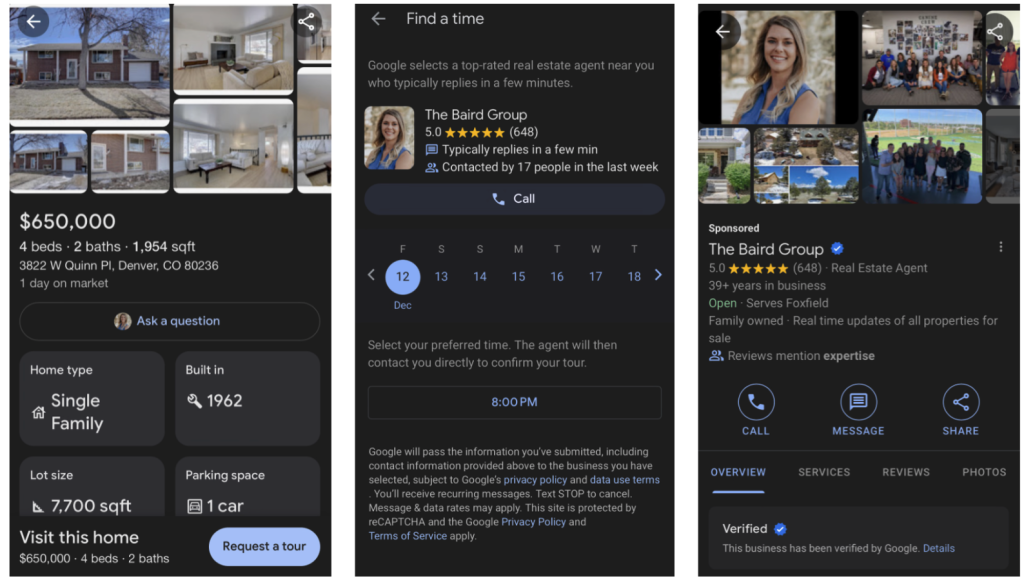
Source: Mike DelPrete
That last point stood out because it hints at where Google is getting its listing data and how it may be positioning itself to play by a different set of rules than traditional portals.
It also highlights the importance of Google reviews; if this feature becomes more widely available, users will be directed to “top-rated agents” in the user’s location.
Why This Raises Real Questions for Portals
Portals exist to aggregate listings, host the consumer experience, and monetize attention through advertising and lead generation.
Google is now testing pieces of that stack inside the place where consumers already start their search.
DelPrete was careful not to jump to conclusions; he framed the development as a test with many possible outcomes.
“There are a lot of potential implications here, from the incumbent portals to exclusive listings to AI and international. But for now it’s all speculation.”
In other words, this is not a Google declaring war on Zillow, et al. But what looks like testing the waters now could develop into a bigger, more in-your-face move down the road.
Wall Street’s Take: Long-Term Risk, Not Immediate Fallout
CNBC’s coverage added financial context after Zillow shares dropped more than 9% following reports of Google’s test. Analysts, however, were quick to separate short-term reaction from longer-term risk.
Goldman Sachs analyst Michael Ng framed the issue as structural rather than immediate.
In a note cited by CNBC, Ng wrote,
“While we don’t expect a direct near-term impact on Zillow’s business, given that most of Zillow’s traffic is direct and Google’s new product is currently limited to select markets and mobile browsers, we view this development as a long-term risk for real estate portals like Zillow.”
Like DelPrete, Ng’s tone is reasonably cautious rather than alarmist. For the time being, Zillow has a clear and overwhelming edge over Google’s limited new feature, which feels more like something in the testing phase than a fully-developed product.
But he also notes Google’s listings resemble an advertising format aimed at buy-side agents, which overlaps directly with portal lead gen models (including Zillow’s).
Other analysts echoed that theme, comparing the test to Google’s hotel search experience, where platforms bid for placement rather than being fully displaced.
The consensus views disintermediation as unlikely in the near term, but competition for attention and economics could get more intense over time, especially if the user response to Google’s experiment encourages further development.
What This Signals Going Into 2026
DelPrete closed his post with a reminder that patience matters here. Tests evolve. Some get killed. Others become foundational. What matters is recognizing the direction of experimentation.
“If you thought 2025 was interesting, 2026 is shaping up to be a zinger.”
In other words, this is something to be aware of, and to keep an eye on. But it won’t spell Zillow’s doom (or anyone else’s) overnight.
Google is experimenting with how real estate discovery works inside search. Portals still own scale, brand, and consumer habits.
That said, distribution power is shifting. And the lines between search portals and platforms are blurring faster than they have in years.
We’ll be watching.